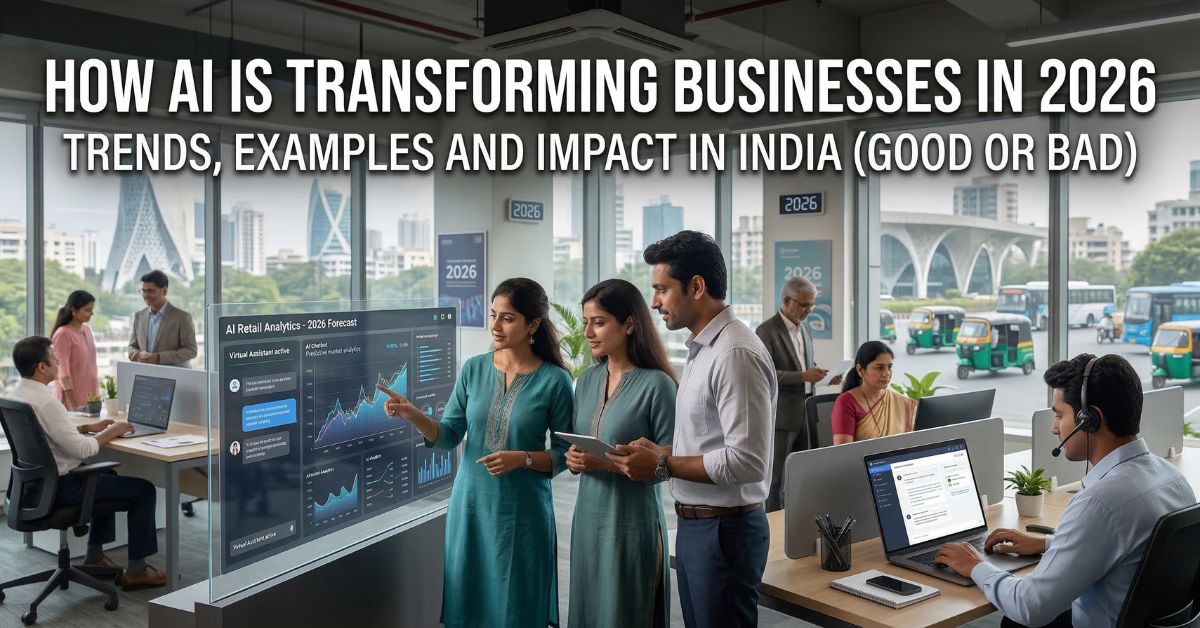
Artificial Intelligence (AI) is no longer just a futuristic concept. By 2026, it has become a core part of How AI Is Transforming Businesses in 2026 operate across the world, including India. From improving customer service to automating complex tasks, companies are integrating AI into daily operations to increase efficiency, reduce costs, and improve decision-making.
In India, both large enterprises and startups are rapidly adopting AI tools, especially generative AI and automation systems. Experts say the technology is moving beyond small pilot projects and is now being deployed at scale across many industries.
This article explains how AI is transforming businesses in 2026, the sectors leading adoption, and what the future could look like for Indian companies.
How AI Is Transforming Businesses in 2026
In 2026, AI is becoming a core technology that powers business operations rather than just supporting them. Many organizations are integrating AI with cloud platforms, data systems, and enterprise software.
Technology research reports show that AI is evolving from experimentation to large-scale adoption, becoming the “backbone” of enterprise architecture and digital systems.
Companies are using AI to automate repetitive work, analyze massive datasets, and generate insights much faster than traditional software systems.
For example, large IT firms such as Tata Consultancy Services, Infosys, and Wipro are developing AI-powered platforms to help businesses automate data analysis, forecasting, and decision-making processes.
How Businesses Are Using AI in 2026
Across industries, companies are applying AI in several practical ways. Instead of limited experiments, AI tools are now embedded in daily operations.
Smarter Customer Support
AI chatbots and conversational assistants can handle thousands of customer queries simultaneously.
In India’s fintech sector, companies like Paytm are using generative AI to improve customer support through automated conversations and personalized assistance.
This reduces response time and helps companies operate customer service teams more efficiently.
Automation of Business Processes
AI is increasingly automating routine tasks such as data entry, reporting, document analysis, and compliance checks.
For example, in industries like insurance and finance, AI systems can process claims, calculate risks, and verify documents automatically, reducing the need for manual work.
This allows employees to focus on more strategic tasks.
Data-Driven Decision Making
Businesses generate huge volumes of data every day. AI tools help analyze this data quickly and provide insights for business strategy.
In supply chain operations, AI-powered platforms can identify suppliers, forecast demand, and optimize procurement processes. Some companies have reported significant improvements in operational efficiency after implementing such systems.
Indian Companies Leading AI Adoption
India has become a major hub for AI development and deployment. The country has a large pool of engineering talent and a growing ecosystem of startups and tech companies.
Many Indian enterprises are investing heavily in AI technologies. Large groups such as Reliance Industries and Tata Group have partnered with global technology firms to strengthen computing infrastructure and AI capabilities.
At the same time, hundreds of startups are building AI tools for sectors like healthcare, fintech, agriculture, and logistics.
Experts also note that India’s cost-effective development ecosystem allows companies to build and deploy AI solutions at scale.
AI Is Reshaping the Workforce
One of the biggest changes in 2026 is the evolving relationship between humans and AI in the workplace.
Many organizations are adopting a “human-AI collaboration” model, where employees work alongside AI systems that assist with research, coding, analysis, and content creation.
Recent industry reports suggest that nearly half of Indian enterprises now have multiple generative AI use cases already running in production environments.
However, this shift also means workers need new skills such as AI literacy, data interpretation, and prompt engineering.
Industries Most Impacted by AI
AI adoption is spreading across almost every industry, but some sectors are seeing faster transformation.
IT and Software Services
India’s IT sector is heavily investing in generative AI to automate software development, testing, and analytics.
Healthcare
AI tools are helping doctors analyze medical scans, detect diseases faster, and improve diagnostics in hospitals.
Manufacturing
Factories are using AI-powered robots and inspection systems to improve product quality and production efficiency.
Retail and E-commerce
AI is used to personalize shopping experiences, recommend products, and optimize supply chains.
Why AI Matters for India’s Economy
AI could significantly boost productivity and innovation in India’s economy. How AI Is Transforming Businesses in 2026 can reduce operational costs, increase efficiency, and create new digital services.
Additionally, AI may help Indian companies compete globally by enabling faster innovation and smarter decision-making.
However, experts say responsible use of AI is equally important. Companies must ensure data privacy, ethical use, and transparent algorithms as adoption grows.
What Happens Next
The next phase of AI adoption in business will focus on agentic AI, autonomous systems capable of performing complex tasks with minimal human input.
Organizations are expected to deploy more advanced AI agents that can manage workflows, assist employees, and handle complex decision processes.
Read More : Claude AI vs ChatGPT
At the same time, governments and regulators around the world—including India—are likely to introduce policies to ensure responsible AI development.
For businesses, the message is clear: AI is no longer optional. It is becoming a fundamental part of modern business strategy.
FAQs(How AI Is Transforming Businesses in 2026)
What does AI mean for businesses in 2026?
AI helps businesses automate tasks, analyze data, improve customer service, and make faster decisions using advanced algorithms and machine learning systems.
Are Indian companies using AI widely?
Yes. Many Indian enterprises now have multiple AI systems running in production, especially in IT services, fintech, and manufacturing.
Will AI replace human jobs?
AI may automate some routine tasks, but it also creates new roles that require AI skills and human creativity.
Which industries are using AI the most?
IT services, healthcare, finance, manufacturing, and retail are among the sectors adopting AI most rapidly.
Why is AI important for business growth?
AI improves efficiency, reduces costs, and enables companies to innovate faster, helping them remain competitive in the global market.