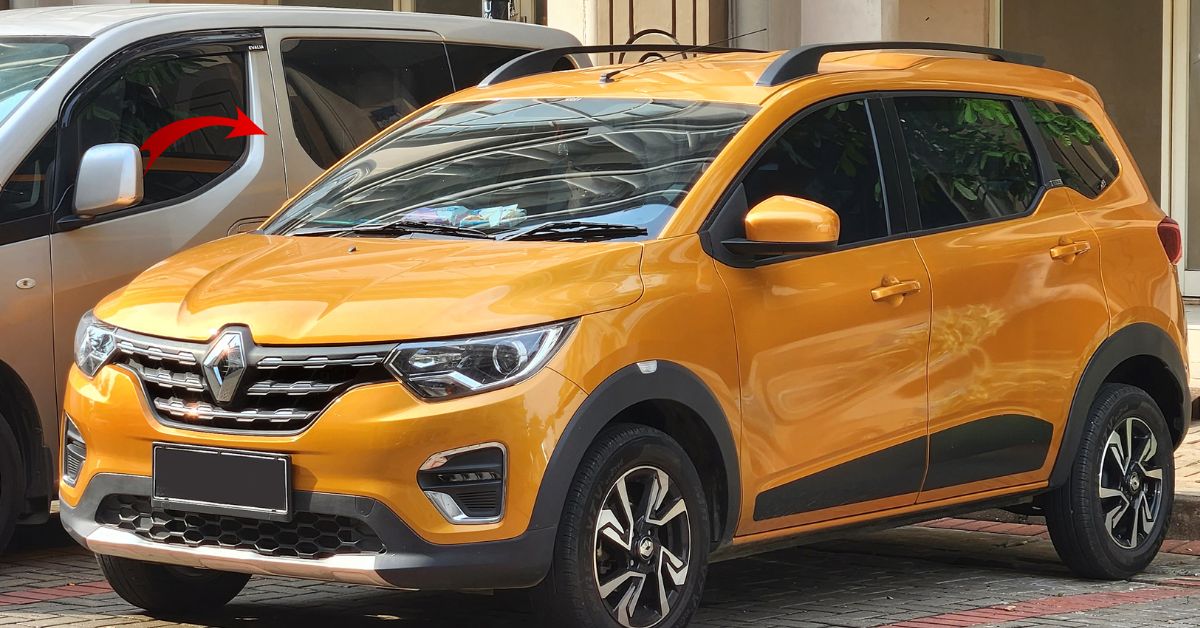
The Renault Triber has been one of the most intelligent and disruptive launches in the Indian automotive market in recent years. Positioned strategically to bridge the gap between B-segment hatchbacks and proper $\text{MPV}$s like the Maruti Ertiga, the Triber offers a staggering 7-seater capacity while remaining under the crucial 4-metre length—a feat of engineering unique in this price segment.
The 2025 Renault Triber Facelift, launched in July 2025, builds upon this core strength. It introduces cosmetic changes, a revamped interior, and most importantly, significant safety and feature enhancements to maintain its competitive edge. This in-depth review analyzes the Triber’s performance, practicality, safety credentials, and overall value proposition in the Indian context, giving a definitive verdict on whether it remains the smartest budget family car.
Price and Variant Structure in India (Ex-Showroom)
The 2025 Renault Triber has a refined variant structure, offering excellent value right from the base model, with the top-end pushing close to the ₹10 Lakh mark (on-road).
| Variant | Transmission | Engine | Ex-Showroom Price (Approx.) |
| Authentic | Manual (MT) | 1.0L Petrol | ₹6.29 Lakh |
| Evolution | Manual (MT) | 1.0L Petrol | ₹7.24 Lakh |
| Techno | Manual (MT) | 1.0L Petrol | ₹7.99 Lakh |
| Emotion | Manual (MT) | 1.0L Petrol | ₹8.64 Lakh |
| Emotion AMT | Automatic (AMT) | 1.0L Petrol | ₹9.16 Lakh |
Export to Sheets
Key Takeaway: The Triber’s starting price is competitive with premium hatchbacks and entry-level $\text{C-SUV}$s, making it the most affordable 7-seater currently available. The AMT option is strategically reserved for the top-end Emotion variant, commanding a premium of around ₹52,000.
Seating Capacity & Interior Modularity: The EasyFix System
The Triber’s true unique selling proposition is its modular seating, which Renault calls the EasyFix system.
A. Seating Configuration
The Triber is designed to be configurable in up to four modes, depending on passenger and luggage needs:
- 7-Seater (Tribality Mode): Maximum passenger capacity, suitable for short city drives with a full load.
- 6-Seater: One-half of the third row is removed, allowing for more luggage space while maintaining a 2+2+2 configuration.
- 5-Seater: The entire third row is removed, transforming the car into a spacious hatchback/C-SUV rival.
- 2-Seater: All rear seats are removed/folded, offering an astonishing 625 Litres of cargo volume.
B. Comfort and Space
- First and Second Row: The 2636 mm wheelbase (long for a sub-4m car) ensures excellent space in the first two rows. The second row can slide, recline, fold, and tumble, significantly boosting flexibility. Dedicated AC vents for the second row are neatly integrated into the B-pillars.
- Third Row: While the third row is cramped for long journeys for adults, it is perfectly usable for children or for short city commutes. Crucially, the third row gets separate AC vents and 12V charging sockets, a rarity in this price bracket.
- Boot Space: With all three rows up, the boot space is a meager 84 Litres. However, removing the third row seats unlocks the massive 625 Litre capacity, making it a highly practical 5-seater.
Engine Performance and Mileage
To achieve its aggressive price point, the Triber relies on a single powertrain option—the naturally aspirated 1.0 Litre ENERGY petrol engine.
A. Engine Specifications
| Specification | 1.0 Litre ENERGY Petrol |
| Displacement | 999 cc (3-Cylinder, Naturally Aspirated) |
| Max Power | 72 PS at 6250 rpm |
| Max Torque | 96 Nm at 3500 rpm |
| Transmission | 5-Speed Manual (MT) / 5-Speed AMT |
Export to Sheets
B. Performance Review: City vs. Highway
- City Driving: The engine is tuned well for city use, where its small size makes it zippy and easy to maneuver. The light steering and compact dimensions are a boon in traffic. The AMT transmission offers clutch-free convenience but exhibits a typical lag between shifts, which is manageable but noticeable.
- Highway & Fully Loaded: This is where the Triber’s modest performance figures are most evident. When fully loaded with 6 or 7 passengers and luggage, the engine feels strained, requiring frequent downshifts (especially in the MT variant) to maintain highway speeds or tackle inclines. Cruising at 90−100 kmph is comfortable, but quick acceleration for overtaking is a task. The rumored 1.0L Turbo-Petrol engine from the Kiger is sorely missed here, as it would significantly boost its highway capability
Read more : Skoda Slavia
C. Mileage and Efficiency
The three-cylinder engine excels in fuel efficiency, a top priority for budget buyers.
| Transmission | ARAI Claimed Mileage | Real-World City Mileage (Approx.) |
| Manual (MT) | 20.0 kmpl | 13−15 kmpl |
| Automatic (AMT) | 17.0 kmpl | 11−13 kmpl |
Export to Sheets
Verdict on Efficiency: The Manual Triber is highly efficient, particularly on the highway, with many owners reporting 18−20 kmpl figures during relaxed cruising, offering excellent long-distance range from its 40 Litre fuel tank.
Safety Rating & Features
Safety is a significant advantage for the Triber, especially for a vehicle in this price segment.
A. Global NCAP Safety Rating
The Renault Triber received a strong 4-Star rating for Adult Occupant Protection and a 3-Star rating for Child Occupant Protection in the 2021 Global NCAP crash tests (based on the older protocol).
Note on Recent Tests: A 2024 GNCAP test for the African market resulted in a lower 2-Star rating due to stricter new protocols and the variant tested lacking certain key features. However, the 4-Star rating for the Indian model remains highly competitive for its segment.
B. Key Safety Enhancements in the 2025 Facelift
Renault has addressed safety concerns by making several crucial features more widely available:
- Airbags: Top variants (Emotion) now come with 6 Airbags (Front, Side, and Curtain), which is segment-leading. Lower variants maintain the minimum standard of 2 Airbags.
- Standard Features: All variants now come with ABS with EBD, Rear Parking Sensors, and ESC (Electronic Stability Control).
- Top-End Features: Higher trims add TCS (Traction Control System), Hill Start Assist (HSA), and a Tyre Pressure Monitoring System (TPMS), significantly enhancing active safety.
The high 182 mm ground clearance is also a passive safety benefit, ensuring the undercarriage clears speed breakers even with a full load.
Features & Technology
The 2025 facelift has modernized the cabin, focusing on connectivity and driver convenience.
A. Interior & Design
The 2025 model introduces a new dual-tone “Greige” interior theme, making the cabin feel airier than the previous black/beige combination.
- Infotainment: An updated 8-inch Media-NAV Touchscreen system features a new, more responsive User Interface (UI) and supports Wireless Apple CarPlay and Android Auto—a fantastic convenience feature.
- Driver Cluster: A 7-inch Digital Instrument Cluster is standard on higher trims, providing clear, modern readouts.
- Convenience: Cruise Control, Auto Headlamps, and Rain-Sensing Wipers are added to the top trims, enhancing the driving experience, especially on the highway.
- Unique Practicality: The Triber features a total of 23 Litres of internal storage, including a cooled glovebox and central console storage. The Smart Access card for keyless entry and lock/unlock is highly convenient.
B. Exterior Styling
The 2025 Triber gets a refreshed look with:
- Redesigned LED Tail-lamps connected by a gloss black panel.
- A refreshed front bumper and grille.
- New colour options, including Amber Terracotta and Shadow Grey.
- Functional roof rails (up to 50 kg load capacity).
Complete Specifications Table
| Feature | Specification |
| Engine | 1.0 Litre ENERGY Petrol, 3-Cylinder, NA |
| Power/Torque | 72 PS/96 Nm |
| Transmission | 5-Speed Manual (MT) or 5-Speed AMT |
| Mileage (ARAI) | 20.0 kmpl (MT) / 17.0 kmpl (AMT) |
| Seating Capacity | 7 Person (Modular EasyFix System) |
| Boot Space | 84 Litres (7-seater) / 625 Litres (5-seater) |
| Ground Clearance | 182 mm |
| Safety Rating | 4-Star GNCAP (Adult Occupant, 2021 Protocol) |
| Airbags | Up to 6 Airbags (Top variants) |
| Infotainment | 8-inch Touchscreen with Wireless Apple CarPlay/Android Auto |
| Unique Features | Removable 3rd Row Seats, AC Vents in 2nd and 3rd Row, Cruise Control. |
Export to Sheets
Ownership Review and Final Verdict
The Renault Triber has established a strong reputation among Indian families seeking maximum utility on a minimum budget.
A. Ownership Pros and Cons (Based on User Feedback)
| Pros (What Owners Love) | Cons (Areas for Improvement) |
| Unbeatable Practicality: True 7-seater flexibility at the price of a hatchback. | Underpowered Engine: Struggles when fully loaded, especially on inclines. |
| High Safety: 4-Star GNCAP rating provides peace of mind. | AMT Jerkiness: The 5-speed AMT is slow and can be jerky in city traffic. |
| Comfortable Ride: Plaint suspension soaks up bad roads well, aided by 182 mm clearance. | Engine Noise: The 3-cylinder engine gets loud and thrashy at high RPMs. |
| Low Maintenance: Service costs are highly competitive due to the common platform. | Plastics: Interior quality, while functional, uses hard plastics and lacks a premium feel. |
Export to Sheets
B. Final Verdict
The Renault Triber 2025 is not a powerhouse, nor is it a luxury vehicle. It is, however, an engineering masterclass in maximizing space and utility within the sub-₹10 Lakh budget.
Who Should Buy It?
- Budget-Conscious Families: The primary target—those who need seating capacity for 6−7 people occasionally but have the budget of a B-segment car.
- City Drivers: Its compact size, light steering, high ground clearance, and AMT make it a superb city runabout.
- Value Seekers: The sheer number of features (6 airbags, ESC, Cruise Control) offered for the price is unmatched.
The Triber continues to be the most practical and flexible car in its segment. If you can accept the modest performance of the 1.0L naturally aspirated engine, the Triber offers an unparalleled value proposition for the Indian family.
Would you like to compare the Renault Triber 2025 against the Maruti Ertiga or the Kia Carens, focusing on the trade-offs between price, power, and seating comfort?