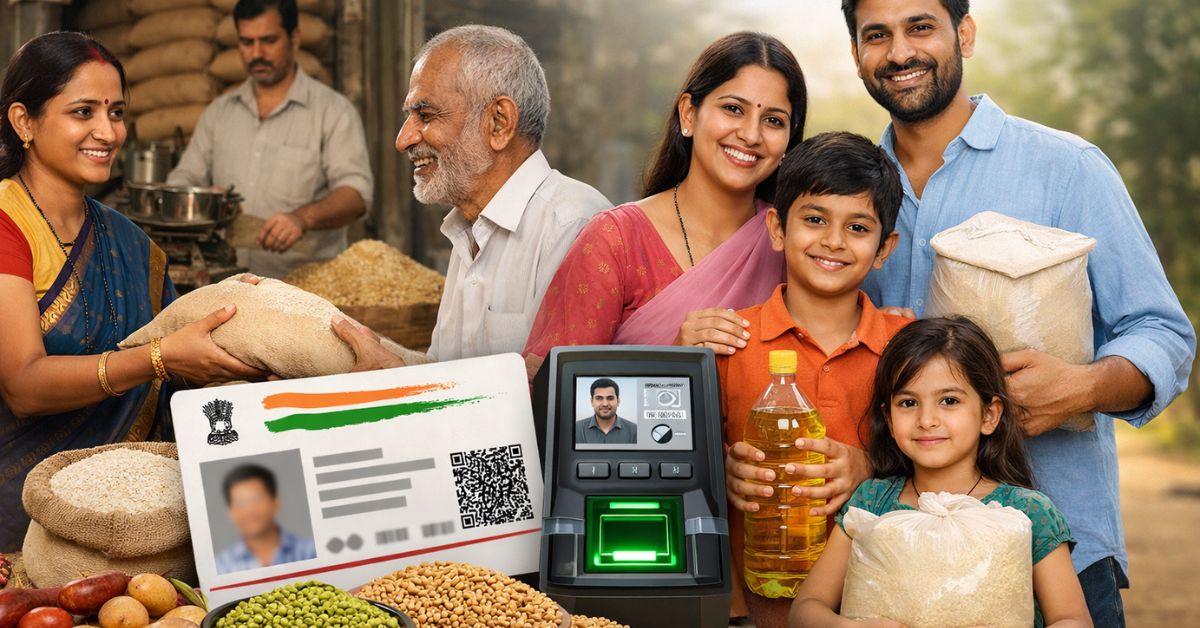
The NFSA 2026 update is becoming an important topic for millions of ration card holders across India. The government is planning new changes under the National Food Security Act (NFSA) to make the free ration system more transparent, digital, and beneficiary-focused. In this article, we explain what the latest update means, who will benefit, and what changes may come into effect in 2026.
What is NFSA and Why It Matters?
The National Food Security Act (NFSA), launched in 2013, is one of India’s largest welfare schemes. It aims to provide subsidised food grains like rice, wheat, and coarse cereals to nearly 81 crore people through the Public Distribution System (PDS).
Under this scheme:
- Eligible families get food grains at low or zero cost
- Antyodaya Anna Yojana (AAY) families get higher benefits
- Priority households receive monthly ration support
This scheme plays a key role in reducing hunger and supporting low-income families across both rural and urban areas.
NFSA 2026 Update: What Has Changed?
As part of the upcoming NFSA 2026 update, the government is working on improving the delivery of ration benefits through technology and better data verification.
Digital Ration Card Integration
One major change expected is the full digitalisation of ration cards. The government is planning to link ration cards with:
- Aadhaar
- Mobile numbers
- Family income databases
This move aims to remove duplicate or fake beneficiaries and ensure that only eligible families receive benefits.
Expansion of “One Nation One Ration Card” System
The One Nation One Ration Card (ONORC) system will likely become stronger by 2026. This allows beneficiaries to collect ration from any state in India, which is especially helpful for migrant workers.
With further improvements expected in 2026:
- Portability of ration will become smoother
- Biometric authentication may become mandatory everywhere
- Real-time beneficiary verification may reduce fraud
Possible Inclusion and Exclusion Updates
The government may also revise eligibility criteria under NFSA. This means:
- New families in need could be added
- Ineligible households may be removed
State governments are already conducting surveys to update beneficiary lists. Families whose income level has increased beyond the limit may no longer qualify for free ration benefits.
Impact on Beneficiaries in India
If implemented properly, the NFSA 2026 update could bring several benefits:
- Fair distribution of ration
- Reduced corruption and leakages
- Better access for migrant labourers
- Faster grievance redressal through digital platforms
However, some concerns remain about biometric failures or internet issues in rural areas. The government may introduce offline backup systems to solve such problems.
What Happens Next?
The central government is expected to work with state governments throughout 2025 to finalise:
- Updated beneficiary lists
- Digital infrastructure at ration shops
- Training for Fair Price Shop (FPS) dealers
Any official rollout of new NFSA rules may happen gradually in phases during 2026.
Beneficiaries are advised to keep their Aadhaar details and ration card information updated to avoid disruption in benefits.
FAQs on NFSA 2026 Update
1. Will free ration continue in 2026 under NFSA?
Yes, the government is expected to continue the free ration scheme with improved delivery systems.
2. Is Aadhaar linking compulsory for NFSA benefits?
In many states, Aadhaar linking is already required and may become fully mandatory by 2026.
3. Can migrant workers get ration in another state?
Yes, under the One Nation One Ration Card system, beneficiaries can collect ration from any state.
4. Will new families be added to the NFSA list?
There is a possibility of new eligible families being added after verification.
5. How can I check my NFSA eligibility?
You can check your eligibility through your state’s food department website or local ration shop.