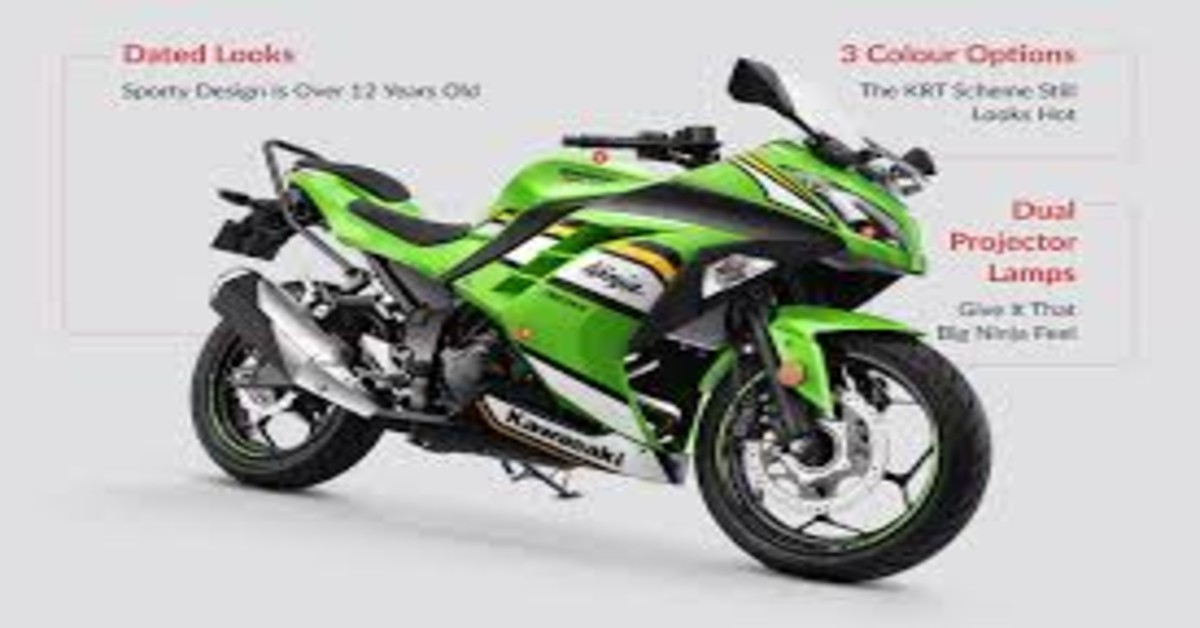
The Kawasaki Ninja 300 is the “Grandfather” of the entry-level twin-cylinder segment in India. While other bikes come and go with fancy TFT screens and riding modes, the Baby Ninja has stubbornly held its ground since 2013. But with the 2025 update bringing in fresh colors and slightly revised features, enthusiasts are asking the same old question: Is it still worth your hard-earned money, or has the competition finally zoomed past?
Currently, the Kawasaki Ninja 300 is priced at ₹3.43 Lakh (Ex-showroom, India). It remains the most affordable way to enter the prestigious “Kawasaki Team Green” family.
Quick Specs Table: The Ninja 300 at a Glance
| Feature | Specification |
| Engine | 296cc, Liquid-cooled, Parallel-Twin |
| Power | 39 PS @ 11,000 RPM |
| Torque | 26.1 Nm @ 10,000 RPM |
| Transmission | 6-speed with Assist & Slipper Clutch |
| Kerb Weight | 179 kg |
| Ground Clearance | 140 mm |
| Fuel Tank | 17 Litres |
| Top Speed | ~160 kmph |
Exterior Design & Road Presence: A Timeless Silhouette
Even after a decade, the Ninja 300 doesn’t look “old.” It looks classic. The sharp twin-pod headlamps (now featuring Projector units in the 2025 model) and the mass-forward design give it a “big bike” look that still turns heads at traffic lights.
The build quality is typical Kawasaki—solid and premium. The paint finish is deep, and the panels don’t rattle, even after years of use. However, compare it to a modern Aprilia RS 457 or the new Yamaha R3, and you’ll notice the Ninja looks a bit compact.
Does it turn heads? Yes, especially in that signature Lime Green. It has that “Ninja” aura that every Indian kid grew up dreaming about.
Read More: Suzuki Boulevard C50
Comfort & Features: The “Old School” Vibe
Ergonomics
Unlike the KTM RC 390, which feels like you’re heading straight to a yoga class, the Ninja 300 is a Sports Tourer. The clip-on handlebars are raised, and the footpegs are only mildly rear-set. You can ride this for 400 km a day without needing a chiropractor.
Features (Or Lack Thereof)
This is where the Ninja 300 shows its age.
- The Good: You get an Assist & Slipper Clutch which makes the lever feel light as a feather.
- The Bad: It still uses an analogue-digital console. No Bluetooth, no Turn-by-Turn navigation, and no Traction Control.
- The Ugly: The Halogen indicators look like they belong in 2010.
Engine Performance & Driving Dynamics
The “Screamer” Parallel Twin
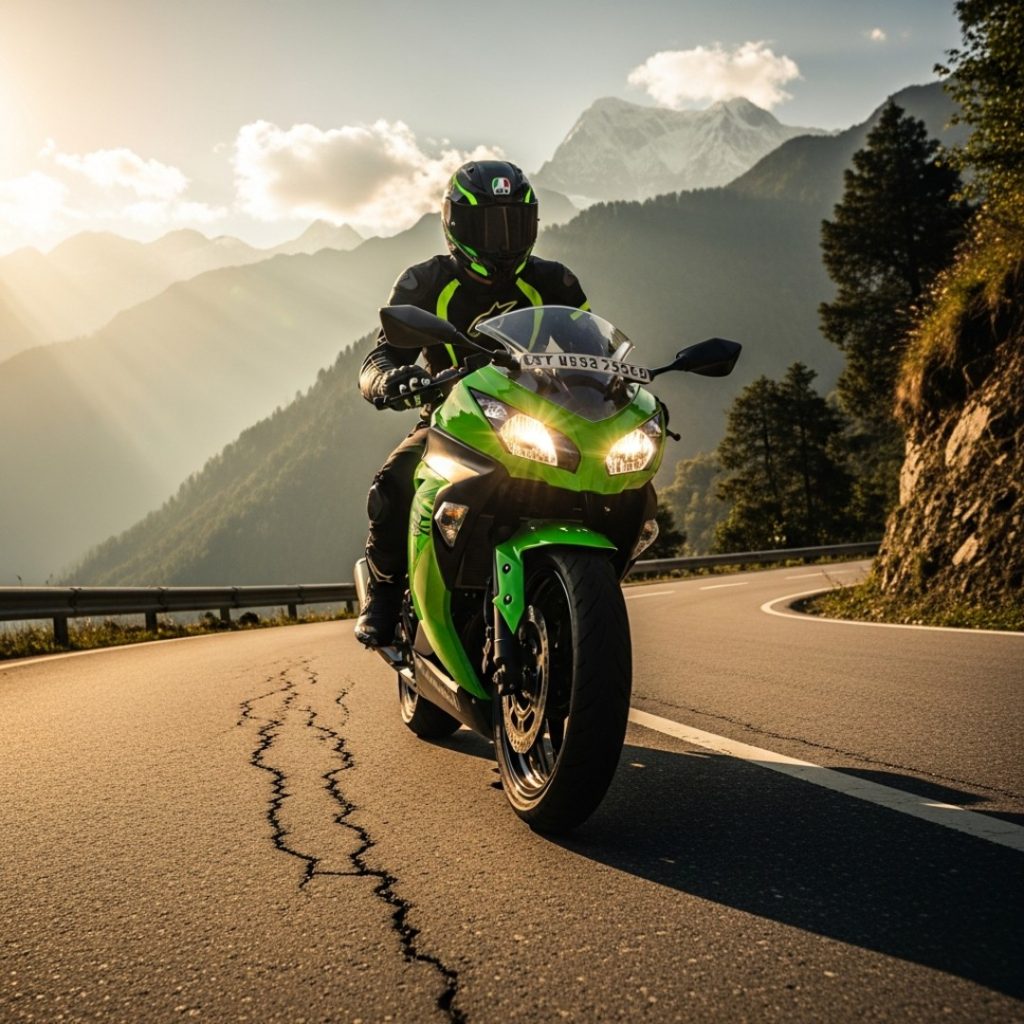
The heart of this machine is the 296cc parallel-twin. It is incredibly refined. At 4,000 RPM, it’s as silent as a commuter, but once you cross 8,000 RPM, the intake howl kicks in, and the bike transforms.
- In the City: The heat management is legendary. Even in crawling Mumbai or Bangalore traffic, the radiator fans blow the hot air downwards, away from your legs.
- On the Highway: It sits comfortably at 100-110 kmph all day long. The stability is rock solid, thanks to its 179 kg weight, which keeps it planted even when heavy trucks breeze past you.
- Suspension & Potholes: The suspension is tuned for comfort. It absorbs potholes easily compared to the stiff KTM. However, the 140mm ground clearance is a major headache. You will scrape the bottom on large Indian speed breakers if you have a pillion.
Safety: The Basics Covered
The Ninja 300 comes with Dual-channel ABS as standard. The braking is handled by a 290mm petal disc at the front. While the bite is progressive, under hard braking, the front telescopic forks dive quite a bit. It’s safe and predictable, but it doesn’t have the “sharpness” of a bike with USD (Upside Down) forks.
Real World Mileage: The Truth
Indian riders always ask, “Kitna deti hai?” (How much does it give?). For a twin-cylinder, the Ninja is surprisingly frugal if you’re gentle.
- ARAI Claimed Mileage: 30 kmpl
- Real World City Mileage: 24 – 26 kmpl
- Real World Highway Mileage: 28 – 32 kmpl
With its massive 17-litre fuel tank, you can easily get a range of 450+ km, making it an excellent touring companion.
The Competition: Ninja 300 vs Rivals
| Feature | Kawasaki Ninja 300 | KTM RC 390 | Yamaha R3 (2025) |
| Engine Type | Parallel-Twin | Single-Cylinder | Parallel-Twin |
| Power | 39 PS | 43.5 PS | 42 PS |
| Features | Basic, Analogue | TFT, TC, Quickshifter | LCD, USD Forks |
| Ex-Showroom Price | ₹3.43 Lakh | ₹3.23 Lakh | ~₹4.65 Lakh |
| Best For | Smoothness/Touring | Track Days/Speed | Brand Value/Refinement |
Winner: If you want Value for Money and features, the KTM RC 390 wins. If you want Twin-Cylinder refinement on a budget, the Ninja 300 is the undisputed king.
Final Verdict
The Kawasaki Ninja 300 is like a classic mechanical watch in a world of smartwatches. It lacks the gadgets, but the core engine experience is something a single-cylinder KTM or TVS just cannot match.
Buy it if:
- You want the smoothest engine in the sub-400cc segment.
- You plan to do long-distance touring with minimal fatigue.
- You want a “Big Bike” feel without the intimidating power.
Skip it if:
- You want modern features like a TFT screen or Traction Control.
- You live in an area with massive speed breakers (Low GC is a pain).
- You want cheap service (Kawasaki spares are expensive!).
Senior Journalist Score: 7.5/10
FAQs (People Also Ask)
What is the on-road price of Ninja 300 in 2025?
Depending on your city, the on-road price ranges between ₹3.90 Lakh to ₹4.15 Lakh.
Does the Ninja 300 have a high maintenance cost?
Yes, compared to KTM or TVS, Kawasaki service is pricier. A standard service will cost you anywhere between ₹6,000 to ₹9,000.
Is there a CNG option for Ninja 300?
No, and there likely never will be. This is a high-performance sports bike.
Can a short rider handle the Ninja 300?
Absolutely. With a seat height of 780mm, even riders who are 5’4″ can easily plant both feet on the ground.