The $150\text{cc} \text{ – } 200\text{cc}$ motorcycle segment is the crucible of performance and practicality in India. Honda, with its reputation for bulletproof reliability and unmatched engine refinement, introduced the Hornet 2.0 to bridge the significant gap between its popular $160\text{cc}$ commuter line and its premium $300\text{cc}$ offerings.
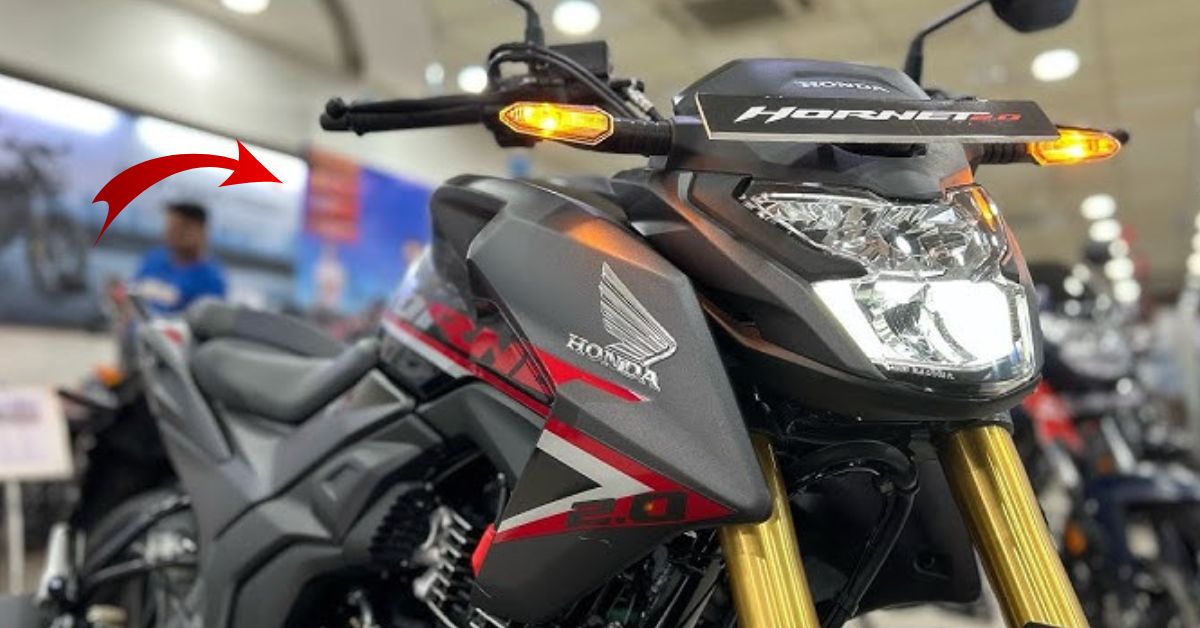
The 2025 Honda Hornet 2.0 is not merely a $\text{BS}6 \text{ Phase} 2$ compliant update; it is a profound technological and safety overhaul. It takes the aggressive streetfighter stance, characterized by the signature golden $\text{USD}$ forks, and injects cutting-edge features like Traction Control ($\text{HSTC}$) and a Dual-Channel $\text{ABS}$ system. This long-form review dissects every aspect of the 2025 Hornet 2.0, from its updated price point to its real-world performance, to determine if it truly delivers the ideal blend of aggression, refinement, and safety.
Price and Feature Positioning: The Premium Proposition
The Hornet 2.0 has always commanded a premium, positioning itself above the fiercely competitive $160\text{cc}$ crowd (like the $\text{Apache} \text{ RTR} 160 4\text{V}$) but undercutting the flagship $200\text{cc}$ models. The 2025 update, with its added technology, solidifies this premium stance.
A. Latest Price Analysis (2025 Model)
The inclusion of the $\text{TFT}$ screen, $\text{Bluetooth}$ connectivity, $\text{HSTC}$, and $\text{Dual-Channel} \text{ ABS}$ pushes the price tag into new territory for Honda in this segment.
| Parameter | Value | Details |
| Ex-Showroom Price (Avg.) | $\mathbf{₹1,45,868 \text{ – } ₹1,56,953}$ | The price is closer to the higher end for the fully-featured 2025 model. |
| On-Road Price (Estimated) | $\mathbf{₹1,75,000 \text{ – } ₹1,90,000+}$ | Varies significantly by state taxes, registration, and insurance. |
| Competition Comparison | Priced higher than most $160\text{cc}$ models and overlaps with some $200\text{cc}$ rivals. | Justifies the price with superior features like $\text{USD}$ forks and $\text{HSTC}$. |
B. Feature Set as Value Proposition
Honda strategically addresses its previous feature deficit. The jump from a basic $\text{LCD}$ to a $\mathbf{4.2\text{-inch} \text{ TFT} \text{ Display}}$ with $\text{Honda} \text{ RoadSync}$ $\text{Bluetooth}$ (for turn-by-turn navigation, call alerts, etc.) dramatically modernizes the cockpit. More importantly, the inclusion of **$\text{Honda} \text{ Selectable} \text{ Torque} \text{ Control}$ ($\text{HSTC}$), or traction control, is a first in the sub-$200\text{cc}$ air-cooled segment, providing a crucial safety edge in wet conditions. This technological package helps justify its premium over direct rivals.
Engine Performance: Punchy Mid-Range with Honda Refinement
At the heart of the Hornet 2.0 is a refined $184.40 \text{ cc}$ single-cylinder, air-cooled engine. While the specifications may look modest compared to liquid-cooled $200\text{cc}$ competitors, the Hornet’s engine is defined by its smooth power delivery and light weight.
A. Engine Specifications
| Feature | Specification | Comment |
| Engine Type | $184.40 \text{ cc}$, Air-cooled, $\text{FI}$ Engine | $\text{OBD}2\text{B}$ compliant (2025 update). |
| Max Power | $\mathbf{16.99 \text{ PS}} \text{ @ } 8500 \text{ rpm}$ | Good power-to-weight ratio due to low kerb weight. |
| Max Torque | $\mathbf{15.7 \text{ Nm}} \text{ @ } 6000 \text{ rpm}$ | Strong mid-range torque, excellent for city overtakes. |
| Gearbox | $5\text{-speed}$ Manual | The major drawback; a $6\text{-speed}$ unit is missed on the highway. |
| Clutch | $\mathbf{Assist \text{ and} \text{ Slipper} \text{ Clutch}}$ | Essential for smooth downshifts and reduced lever effort. |
B. Riding Dynamics and Power Delivery
- City Tractability: The Hornet 2.0 truly shines in urban traffic. The engine is exceptionally tractable, thanks to the short gearing and strong mid-range torque peaking early at $6000 \text{ rpm}$. You can comfortably cruise in $5^{\text{th}}$ gear at speeds as low as $30 \text{ kmph}$ and roll on without excessive gear shifts, a testament to the flexibility of the $184 \text{ cc}$ block.
- The Honda Smoothness: As expected from Honda, the engine refinement is superior. Vibrations are minimal up to $7500 \text{ rpm}$. The engine note is quiet and sophisticated, lacking the mechanical roughness found in some competitors. This smoothness translates to a less fatiguing ride over long city commutes.
- The $5\text{-speed}$ Bottleneck: While the $5\text{-speed}$ gearbox is slick and perfectly paired with the $\text{A} \& \text{S}$ clutch, the lack of a $6^{\text{th}}$ gear is acutely felt on the highway. Sustained cruising above $100 \text{ kmph}$ pushes the $\text{rpm}$ high, introducing mild vibrations and making the engine feel a little stressed, hurting its long-distance touring credentials.
- Acceleration: The Hornet 2.0 is quick on its feet. Its light $142 \text{ kg} \text{ kerb} \text{ weight}$ combined with the short gearing delivers brisk $0 \text{ – } 60 \text{ kmph}$ times (around $3.7$ seconds in previous tests), making it competitive with some $200\text{cc}$ bikes in quick sprints.
Mileage Test: Practical Fuel Efficiency
Despite its sporty classification, the Hornet 2.0, benefits from Honda’s $\text{HET} \text{ (Honda} \text{ Eco} \text{ Technology})$ and $\text{PGM} \text{-FI}$ (Programmed Fuel Injection).
A. Real-World Fuel Economy
| Scenario | Claimed/Reported Mileage | Real-World Expectation |
| ARAI Certified | $42.3 \text{ kmpl}$ (Older figure) | A baseline for competitive comparison. |
| City Commuting (Reported) | $\mathbf{45 \text{ – } 48 \text{ kmpl}}$ | Excellent for the displacement, due to light weight and smooth engine. |
| Highway Cruising (Reported) | $\mathbf{50 \text{ – } 55 \text{ kmpl}}$ | Achievable at efficient cruising speeds ($80 \text{ – } 90 \text{ kmph}$). |
B. Mileage Verdict
An average user can realistically expect a return of $45 \text{ – } 50 \text{ kmpl}$ in mixed riding conditions. Considering the $184.4 \text{ cc}$ engine and performance, this is a very strong showing, often matching or even beating some $160\text{cc}$ rivals. The $\mathbf{12 \text{ Litre}}$ fuel tank capacity provides a dependable range of $\mathbf{500 \text{ – } 600 \text{ km}}$ between refills.
Handling, Safety, and Chassis Mastery
The suspension and safety hardware are where the 2025 Hornet 2.0 makes its boldest statement, offering a package previously reserved for much higher price points.
A. Suspension and Handling
- Golden $\text{USD} \text{ Forks}$: The Upside Down (USD) front forks are the visual and functional highlight. Inverted forks increase rigidity, significantly improving steering feedback and stability during hard braking. This translates to a bike that is incredibly eager to turn into corners, making the Hornet a genuine joy on twisty roads.
- Monoshock Rear: Paired with the $\text{USD}$ front, the adjustable monoshock rear suspension provides a firm, sporty ride. While some riders might find it a touch stiff over broken city roads, this stiffness is key to its exceptional cornering ability and high-speed stability.
- Lightweight Chassis: At $142 \text{ kg}$, the Hornet is one of the lightest bikes in its category. This low weight contributes directly to its flickability in traffic and its ease of handling, especially for new or younger riders.
B. Segment-Leading Safety Features
The 2025 update brings the Hornet 2.0’s safety package to a new level, setting a standard for its class:
- Dual-Channel $\text{ABS}$: The transition from single-channel to Dual-Channel $\text{ABS}$ is a massive safety upgrade. It provides anti-lock braking on both the $276 \text{ mm}$ front and $220 \text{ mm}$ rear disc brakes, minimizing the risk of wheel lock-up during panic braking on slippery surfaces.
- $\text{HSTC}$ (Traction Control): The inclusion of $\text{Honda} \text{ Selectable} \text{ Torque} \text{ Control}$ is unprecedented in this segment. This system detects rear wheel spin (especially on wet or sandy roads) and momentarily cuts power to restore grip, drastically improving rider confidence and safety in adverse conditions.
Read more : Honda Unicorn 160
Comfort, Ergonomics, and Design
The design language is aggressive streetfighter, and the ergonomics support a committed, yet manageable riding posture.
A. Design and Aesthetics
The Hornet 2.0 is visually striking. The muscular tank, sharp tank shrouds, and split-seat design give it a premium, naked-sport bike appearance. The all-$\text{LED}$ lighting system, including the $\text{X}$-shaped $\text{LED}$ tail lamp, ensures it stands out day and night. The golden $\text{USD}$ forks are the crowning visual touch that immediately signals its premium status.
B. Rider and Pillion Comfort
- Rider Posture: The riding posture is sporty, featuring slightly rear-set footpegs and a moderately lowered handlebar. It leans the rider slightly forward, which is ideal for spirited riding and maintaining control during cornering, but remains comfortable enough for daily city commuting.
- Seat Comfort: The split seat setup, while aesthetically appealing, is generally firmer than Honda’s commuter models. The rider’s seat is acceptable for short trips, but the pillion seat is narrow and high-set, making it less comfortable for long-distance pillion riders—a common trade-off in the naked streetfighter category.
The Ownership Verdict
The Honda Hornet 2.0 is a motorcycle that offers more than the sum of its parts. It delivers the signature Honda reliability and refinement wrapped in an aggressive, tech-forward package.
Pros: The Defining Strengths
- Premium Hardware: Segment-leading features like $\text{USD}$ front forks, $\text{TFT} \text{ Display}$, $\text{Dual-Channel} \text{ ABS}$, and $\text{HSTC}$.
- Exceptional Refinement: The $184.4 \text{ cc}$ engine is buttery smooth with minimal vibrations below $7500 \text{ rpm}$.
- Agile Handling: The combination of low weight and stiff suspension makes it a corner-carving machine in the city and on winding roads.
- Great Mileage: High fuel efficiency for its displacement, making it a viable daily rider.
Cons: The Trade-Offs
- $5\text{-Speed} \text{ Gearbox}$: The biggest limitation, restricting comfortable high-speed highway cruising.
- High Price Tag: The premium features push the price close to more powerful $200\text{cc}$ bikes.
- Stiff Suspension/Pillion Seat: While great for handling, the stiff setup compromises plush comfort on bad roads, especially for the pillion.
- Air-Cooled Engine: Lacks the advanced liquid-cooling of some direct competitors, potentially impacting performance consistency in extreme conditions.
Final Conclusion:
The 2025 Honda Hornet 2.0 is the ultimate choice for the rider who values sophistication and safety over outright raw horsepower. It’s a premium, sharp-handling, and feature-rich package that delivers the best of Honda’s legendary engine smoothness. If your riding is $80\%$ city and $20\%$ highway, and you prioritize $\text{USD}$ forks, $\text{HSTC}$, and $\text{TFT}$ connectivity, the Hornet 2.0 offers a unique, compelling, and technologically advanced experience that is worth the premium price tag.
Would you like a detailed comparison of the Honda Hornet 2.0 against its main rivals, the TVS Apache $\mathbf{RTR} 200 4\text{V}$ and the Bajaj Pulsar NS200?