Since the inception of the 288 GTO, Ferrari has reserved its ultimate designation for a select line of limited-production hypercars—machines that encapsulate the pinnacle of Maranello’s engineering and design capabilities for their era. From the raw, analogue brutality of the F40 and the high-revving V12 music of the F50 to the hybrid complexity of the LaFerrari, each car has defined its decade.
Now, a new king has ascended: the Ferrari F80.
Revealed in late 2024 and set to commemorate the company’s 80th anniversary in 2027, the F80 is not just faster than its predecessor; it is a seismic philosophical shift. It boldly ditches the naturally aspirated V12 that crowned the LaFerrari, choosing instead a ferocious, race-derived twin-turbo V6 hybrid powertrain. Limited to just 799 coupé units (all of which are sold out), the F80 sets a new, uncompromising benchmark for performance, aerodynamics, and digital integration, solidifying its place as the definitive hypercar of the 2020s.
The Hybrid System & Powertrain: Le Mans Meets Maranello
The most controversial and defining feature of the F80 is its powertrain. Designed to draw a direct line from Ferrari F80 current motorsport dominance—specifically the 499P Le Mans winning Hypercar and the Formula 1 hybrid architecture—the F80’s core is a mid-mounted V6 engine mated to an advanced 800-volt hybrid system.
A. The F163 CF V6: A 900 \text{ PS} Masterpiece
The internal combustion engine (ICE) is a 2.9 L (2,992 cc) twin-turbo V6 with a 120∘ V-angle, a configuration first seen in the 296 GTB. However, the F80’s engine, designated F163 CF, is an extreme development of this architecture, directly inheriting technology from the 499P World Endurance Championship racer.
- Raw Power: The turbo V6 engine alone generates an astounding 900 PS (888 hp), making it the most powerful internal combustion engine ever produced by Maranello.
- Specific Output: This results in a world-beating specific power output of ∼300 hp/L, achieved through aggressive tuning and staggering 3.7 bar (55.5 psi) of boost pressure.
- E-Turbos: The F80 is Ferrari’s first road car to feature electric turbo technology (e-turbos), where a small electric motor is placed between the turbine and compressor. This F1-derived tech virtually eliminates turbo lag, providing the instantaneous throttle response previously only associated with naturally aspirated engines.
- High Revving: The engine maintains the Ferrari tradition of screaming engines, revving out to a dizzying 9,200 rpm.
B. The Tri-Motor Hybrid Architecture
The ICE is seamlessly integrated with a sophisticated hybrid system featuring three high-performance electric motors, all designed and manufactured in-house by Ferrari.
| Component | Location | Role & Power |
| ICE | Rear Mid-Engine | 900 PS (Primary power) |
| Electric Motors | Two on Front Axle | Provide power boost and e4WD capability (141 hp each, estimated). |
| MGU-K Motor | Attached to Rear of Engine | Provides power boost and functions as an energy recovery unit (ERU) for braking regeneration. |
| Battery | Behind Seats | 2.28 kWh,800-Volt Li-ion (Used strictly for high-power boost and recovery). |
| Total System Output | All Four Wheels | 1200 PS (1184 hp) |
Export to Sheets
The system uses the 800-volt architecture for extremely fast charge and discharge cycles, allowing the electric power to be deployed immediately and consistently. Crucially, the two electric motors on the front axle provide electronic All-Wheel Drive (e4WD), a game-changing feature for traction and corner-exit speed.
Read more : Tata Tiago
Performance Details: Fiorano’s New Record Holder
The 1184 hp combined power output, channeled through an 8-speed dual-clutch F1 DCT gearbox and the new e4WD system, translates to performance figures that set a new global benchmark for the road-legal hypercar class.
| Performance Metric | Ferrari F80 Figure | LaFerrari Comparison |
| Power Output | 1184 hp / 1200 PS | 950 hp (F80 is 234 hp more powerful) |
| 0 – 100 km/h (62 mph) | 2.15 seconds | ∼2.6 seconds |
| 0 – 200 km/h (124 mph) | 5.75 seconds | ∼6.9 seconds |
| Top Speed | \mathbf{350 \text{ km/h} \text{ (217 \text{ mph})} | 350 km/h (217 mph) |
| Fiorano Lap Time | 1:15.30 | 1:19.70 (F80 is over 4 seconds faster) |
Export to Sheets
The ability to achieve 0 – 100 km/h in just 2.15 seconds is primarily credited to the all-wheel-drive traction provided by the front e-axle. The colossal drop of over four seconds on the Fiorano test track lap time proves the F80’s technical superiority not just in straight-line speed, but in real-world track capability, cornering speed, and braking performance—driven largely by the F1-derived hybrid boost and extreme aerodynamics.
Design Language: Brutalism Forged by Airflow
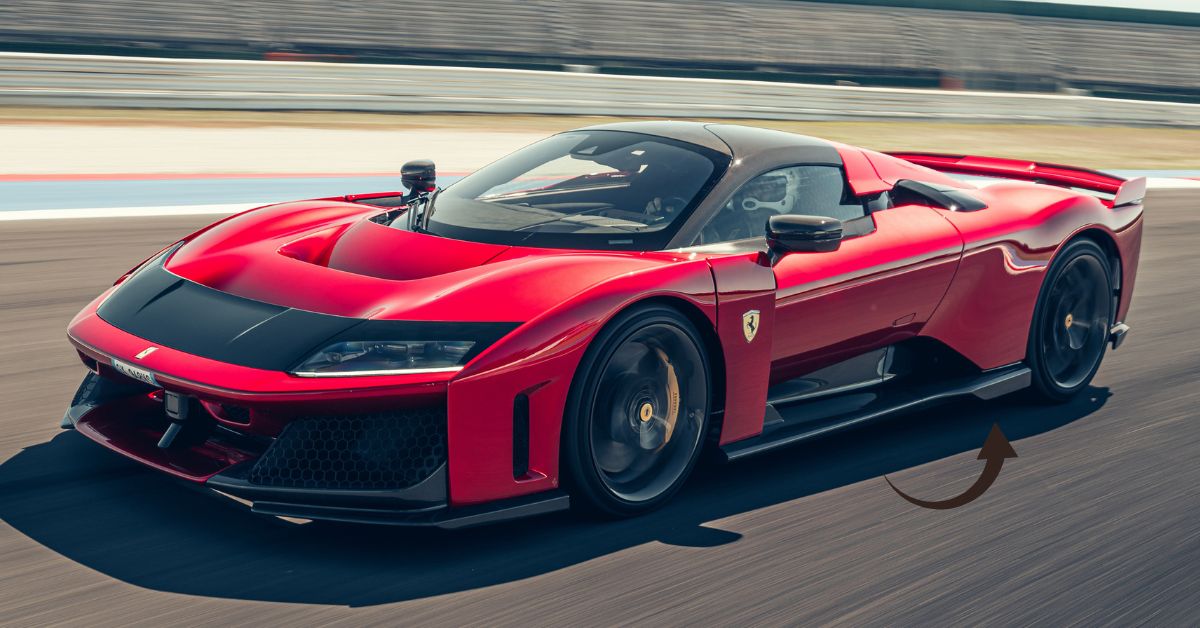
The F80’s styling, overseen by Ferrari Chief Design Officer Flavio Manzoni, is a dramatic departure from the organic curves of the LaFerrari, embracing an aggressive, aerodynamic brutalism that reflects its motorsport origins.
A. Aerospace and F1 Cues
Every surface of the F80 is shaped by its need to manage airflow for downforce and cooling.
- The Visor Nose: The front end features a distinct, blacked-out ‘visor’ that integrates the slim, squared-off headlights. Manzoni describes this as connecting the car to the world of sci-fi, moving away from the “two eyes and a mouth” traditional supercar layout. The ‘visor’ is reminiscent of the black band seen on the 12Cilindri.
- Active Aero Integration: The nose features a complex triplane front wing with an S-Duct system, channeling air through the bonnet to generate downforce with minimal drag. The active rear wing is the main protagonist, capable of infinite adjustment between High Downforce (HD) and Low Drag (LD) positions based on real-time driving conditions.
- The 1000 kg Downforce Target: At 250 km/h, the F80 generates a staggering 1000 kg of downforce, primarily thanks to the massive rear diffuser and flat underbody—the highest figure ever seen on a road-legal Ferrari, placing it on par with top-tier endurance racers.
B. The 1+1 Cockpit
The extreme pursuit of aerodynamic efficiency dictated a narrower carbon fiber tub, leading to an innovative interior layout.
- Driver-Centricity: The cabin is designed with an asymmetric, “1+1” configuration. The driver is the unequivocal focus, with all controls centered around them in an enveloping cockpit that feels like an enclosed Formula 1 car.
- Staggered Seating: The passenger seat is fixed, integrated into the trim, and staggered slightly further back than the driver. This arrangement allowed the central tub width to be reduced by 50 mm, benefiting drag and weight without compromising the driver’s space.
- Practicality: In a surprising nod to usability, the F80 features a storage space behind the seats large enough to accommodate a 24-hour suitcase, complete with straps—a first for a Ferrari hypercar.
Chassis & Technology: The Electronic Foundation
The F80’s performance is not just raw power; it’s the result of highly sophisticated electronic controls working in concert with a state-of-the-art chassis.
A. Advanced Chassis and Suspension
The foundation is an all-new carbon fibre chassis that is 50% stiffer than the LaFerrari’s tub. Despite the added weight of the hybrid components, the dry weight is contained to 1,525 kg (3,362 lbs), a reduction of 60 kg from its predecessor.
- Active Suspension: A key innovation derived from the Purosangue is the 48-volt active suspension system. Each of the four sophisticated Multimatic dampers includes an electric motor that can actively apply force to the damper rod. This technology controls the ride height instantaneously, actively eliminating the need for traditional anti-roll bars, maximizing aerodynamic ground effect, and ensuring optimal grip through every phase of a corner.
- Braking System: Stopping power comes from motorsports-derived CCM-R Plus technology, ensuring maximum deceleration to complement the aggressive acceleration figures.
B. The Digital Command Center
The e4WD system is managed by Ferrari’s proprietary control software, which is critical to deploying the power effectively.
- E-Axle Management: The front electric axle allows for precise torque vectoring, enabling the F80 to maximize corner-exit speed while maintaining a natural, slightly oversteer-biased balance that Ferrari drivers crave.
- Manettino Modes: The signature Manettino switch on the steering wheel allows the driver to toggle between modes (Wet, Sport, Race, CT Off, ESC Off), instantly reconfiguring the engine mapping, hybrid deployment, ABS settings, and the active aero and suspension for any condition.
Complete Technical Specifications
| Feature | Detail / Specification |
| Production Run | 799 Coupés (All Reserved) |
| Price (Estimated) | ∼$3.7 Million / £3.1 Million |
| Engine (ICE) | 2.9 L (2,992 cc) F163 CF 120∘ Twin-Turbo V6 (Derived from 499P) |
| Max ICE Power | 900 PS (888 hp) @ 9200 rpm |
| Specific Output | ∼300 hp/L |
| Electric Motors | 3 (2 Front Axle, 1 Rear MGU-K) |
| Combined Power | 1200 PS (1184 hp) |
| Transmission | 8-speed Dual-Clutch F1 DCT |
| Drivetrain | e4WD (Electronic All-Wheel Drive) |
| Battery | 2.28 kWh,800-Volt Li-ion |
| 0 – 100 km/h (62 mph) | 2.15 seconds |
| 0 – 200 km/h (124 mph) | 5.75 seconds |
| Top Speed | \mathbf{350 \text{ km/h} \text{ (217 \text{ mph})} |
| Downforce (at 250 km/h) | \mathbf{1000 \text{ kg} \text{ (2,205 \text{ lbs})} |
| Dry Weight | 1,525 kg (3,362 lbs) |
| Suspension | 48-Volt Active Multimatic Dampers |
Export to Sheets
VII. Conclusion: The V6 Superiority
The unveiling of the Ferrari F80 officially closes the V12 chapter for Ferrari’s flagship hypercars, a move that could be viewed as sacrilege by purists. However, the performance data clearly supports the Maranello engineers’ choice.
By combining the 300 hp/L twin-turbo V6 (a configuration optimized for Le Mans and F1) with the immediate, all-wheel-drive thrust of the electric motors, Ferrari has created a car that is not only faster in every metric than the V12-powered LaFerrari but also lighter and infinitely more sophisticated in its handling dynamics. The F80 is a statement that the future of extreme performance is hybrid, e4WD, and dictated by the uncompromising demands of aerodynamics. It is a technological, aesthetic, and performance masterpiece—a worthy centerpiece for Ferrari’s next 80 years
Would you like to explore the 499P Le Mans Hypercar in more detail to see the direct racing heritage of the F80’s engine?