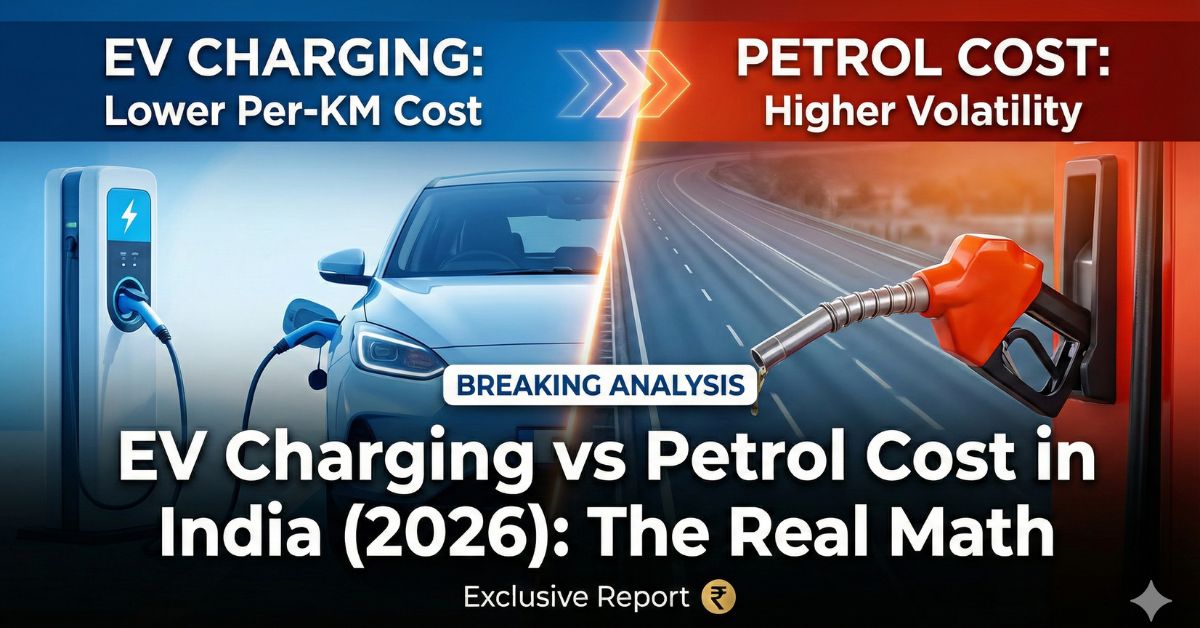
The biggest debate for any Indian car buyer today is simple: Should you buy a petrol car or pay extra for an Electric Vehicle (EV)?
In 2026, the gap between petrol prices and electricity tariffs has made this decision clearer. While petrol prices have remained high across most Indian states, EV charging costs vary hugely depending on where you charge—at home or a public station.
This article breaks down the real per-kilometer cost, current rates in India, and how much money you actually save.
1. Running Cost Comparison (Per Kilometer)
The most important number for your wallet is the “Running Cost.” This is how much you spend to drive 1 kilometer.
Petrol Car Cost:
- Average Petrol Price: ₹95 – ₹105 per litre (varies by state).
- Average Mileage: 12 – 15 km per litre (city driving).
- Cost Per Km: ₹6.50 – ₹8.50
Electric Vehicle (EV) Cost:
- Battery Efficiency: Most Indian EVs run 7–8 km per Unit (kWh).
- Home Charging Rate: ₹6 – ₹8 per Unit.
- Cost Per Km (Home): ₹0.80 – ₹1.20
Verdict: Driving an EV is roughly 85% cheaper than driving a petrol car if you charge at home. If you drive 40 km daily, a petrol car costs you ~₹300/day, while an EV costs just ~₹40/day.
2. Home Charging vs. Public Charging: The Price Trap
Many new buyers do not realize that public charging is much more expensive than home charging. You must know the difference.
Home Charging (Slow & Cheap)
This is where 90% of charging happens. You plug your car into a standard wall socket or a dedicated 7.2kW AC charger installed at your parking spot.
- Cost: You pay domestic electricity rates (or special EV tariffs in states like Delhi, Maharashtra, and Karnataka).
- Rate: Approx ₹6 to ₹9 per unit.
Public Fast Charging (Fast & Costly)
These are DC Fast Chargers found at malls, highways, and petrol pumps. They charge your car in 40–60 minutes but charge a premium fee.
- Cost: Operators charge for electricity + service fee + GST.
- Rate: ₹18 to ₹25 per unit.
- Running Cost: ₹2.50 – ₹3.50 per km.
Even at expensive public stations, an EV is still half the cost of a petrol car, but home charging is where the real magic happens.
3. Maintenance: The Silent Savings
Fuel is not the only expense. Petrol cars have thousands of moving parts (engine, gears, clutch, spark plugs) that wear out. They need oil changes and filter replacements every 6 months.
EVs have very few moving parts. There is no engine oil, no gearbox, and no spark plugs.
- Petrol Service Cost: ₹10,000 – ₹15,000 per year.
- EV Service Cost: ₹2,000 – ₹4,000 per year (mostly for AC filter, brake fluid, and software checks).
Over 5 years, an EV owner saves roughly ₹50,000 just on service bills compared to a petrol car owner.
4. Why EV Prices Are Higher (And When You Break Even)
The main problem with EVs is the “Upfront Cost.” An electric car is usually ₹3 Lakh to ₹5 Lakh more expensive than a similar petrol car because the battery is costly.
Is it worth paying extra? Let’s do the math. If you save roughly ₹70,000 per year on fuel and maintenance:
- Year 1: You save ₹70,000.
- Year 3: You save ₹2,10,000.
- Year 5: You save ₹3,50,000.
The Rule of Thumb: If you drive more than 30-40 km per day, you will recover the extra price of the EV within 3 to 4 years. After that, all your driving is effectively “free” compared to a petrol user. If you drive very less (e.g., only 10 km/day), a petrol car might still be financially safer for you.
5. What Should You Do in 2026?
- Choose Petrol If: You drive very less (under 500 km/month), you travel frequently to remote villages with no chargers, or you have a tight budget for purchasing the car.
- Choose EV If: You have a fixed parking spot with a plug point, you drive over 1,000 km/month, and you want to avoid fluctuating fuel prices.
Read More : What Happens If You Skip Car Service in India?
Frequently Asked Questions (FAQs)
1. Is it cheaper to charge an EV at night?
Yes, in some states like Karnataka and Maharashtra, electricity boards offer “Time of Day” (ToD) tariffs where electricity is cheaper during late-night hours (e.g., 10 PM to 6 AM).
2. How much does a full charge cost for a Tata Nexon EV or MG ZS EV?
At Home (₹8/unit): ₹320 for a full charge (Runs ~300 km).
At Public Station (₹20/unit): ₹800 for a full charge.
Petrol equivalent for 300 km: ₹2,200.
3. Does the battery degrade and lose value?
Yes, batteries degrade slightly over time. However, most manufacturers in India offer an 8-year or 1,60,000 km warranty on the battery. By the time the warranty expires, the fuel savings usually cover the cost of the car itself.
4. Will electricity prices rise like petrol?
Electricity prices are regulated by the government and rise very slowly (usually 2-5% per year). Petrol prices are linked to global oil markets and can spike suddenly.