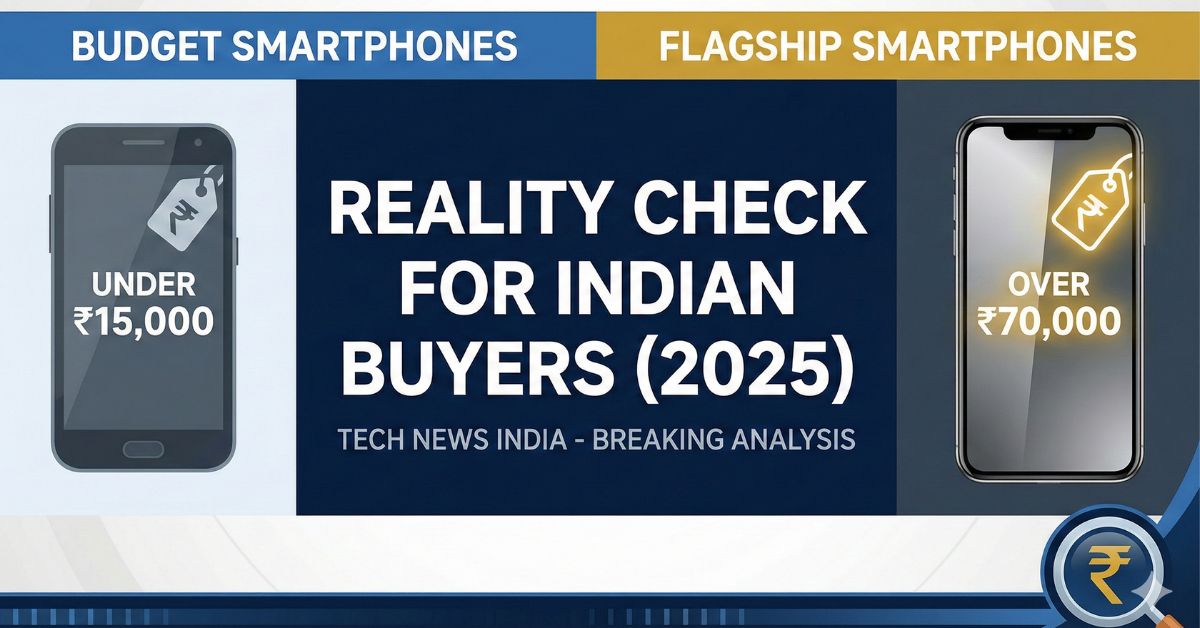
In 2025, buying a smartphone in India has become a tricky game. A few years ago, a ₹15,000 phone felt slow and took blurry photos, while a ₹80,000 flagship was the only way to get a smooth experience. Today, that gap has almost vanished.
If you are confused between saving money with a budget 5G phone or splurging on the latest iPhone or Samsung Galaxy S-series, you are not alone. Does paying four times the price give you four times the performance?
This guide breaks down the real-world differences between cheap (Budget/Mid-range) and expensive (Flagship) phones in the Indian market to help you decide.
1. The Design and Build Quality
When you hold a flagship phone like the iPhone 16 or Samsung Galaxy S25 Ultra, it feels like jewelry. They use titanium, glass, and ceramic frames that feel cold and premium. They are also usually rated IP68, meaning they can survive a dip in the swimming pool.
On the other hand, budget phones (under ₹20,000) like the Redmi Note series or Samsung M-series mostly use high-quality plastic or polycarbonate. While they might not feel as “expensive,” they are actually more durable against drops because plastic doesn’t shatter like glass.
Expert Note: If you put a back cover on your phone (which 90% of Indians do), the premium feel of a glass back is hidden anyway.
2. Display: The Gap Has Closed
This is where cheap phones have caught up the most.
- Cheap Phones: You can now get excellent AMOLED screens with 120Hz refresh rates in phones under ₹20,000 (e.g., from Motorola, POCO, or Realme). They look sharp, colorful, and smooth.
- Expensive Phones: They offer “LTPO” technology, which saves battery by adjusting smoothness automatically. They are also much brighter outdoors. If you use your phone under direct Indian sunlight often, a flagship is easier to read.
3. Camera: The Real Differentiator
This is the main reason people pay extra.
- Budget Phones: They often boast “108MP” or “200MP” cameras, but numbers can be misleading. In good daylight, they take great photos. However, in low light or indoors, the images can look grainy. Video recording is usually shaky because they lack OIS (Optical Image Stabilization).
- Flagship Phones: It’s not about megapixels; it’s about the sensor size and software. A flagship will give you clear night shots, stable 4K videos, and better zoom (telephoto lenses). If you are a content creator or a parent who wants clear photos of moving kids, an expensive phone is worth it.
4. Performance and Speed
Do you feel the difference?
- Daily Use: For WhatsApp, Instagram, YouTube, and UPI payments, a ₹20,000 phone with a Snapdragon or Dimensity chip is perfectly fast in 2025. You won’t notice lag.
- Gaming & Heavy Work: If you play games like BGMI or Genshin Impact at high settings, or edit videos on your phone, a flagship with a top-tier processor (like Snapdragon 8 Elite or Apple A-series) is necessary. They don’t heat up as fast and keep running smoothly for years.
5. Software Updates and Longevity
This is a hidden cost of cheap phones.
- Cheap Phones: Usually get 1 or 2 major Android updates. After 2 years, the phone might start feeling “old” or stop getting security patches for banking apps.
- Expensive Phones: Brands like Samsung and Google now offer 7 years of OS updates. An expensive phone bought in 2025 will arguably run the latest software until 2032. This makes them a better long-term investment.
6. Battery Life and Charging
Surprisingly, cheaper phones often win here!
- Cheap Phones: They prioritize battery life over slim designs. It is common to find massive 6,000mAh batteries in budget Samsung or Moto phones that last 2 days.
- Expensive Phones: Due to powerful processors and bright screens, they typically last one full day. However, Chinese flagships (like OnePlus or Xiaomi) offer crazy fast charging (100W+) that fills the battery in 20 minutes, whereas Apple and Samsung are slower.
Verdict: Which One Should You Buy?
Buy a Budget/Mid-Range Phone (₹15,000 – ₹30,000) if:
- You use your phone mostly for social media, calls, and videos.
- You tend to change your phone every 2–3 years.
- You want excellent battery life.
- You are okay with “good enough” photos.
Buy an Expensive/Flagship Phone (₹60,000+) if:
- You keep your phone for 4+ years.
- You need the best possible camera for work or memories.
- You play heavy mobile games.
- Resale value matters to you (iPhones hold value best in India).
Frequently Asked Questions (FAQs)
Q1: Do expensive phones have better network reception in India?
Not necessarily. Network reception depends more on your telecom operator (Jio/Airtel) and your location. However, expensive phones often support more 5G bands, which might be useful if you travel internationally.
Q2: Is a ₹1 lakh phone 5 times better than a ₹20,000 phone?
No. It follows the law of “diminishing returns.” You pay a lot more for small improvements like 10% better camera or slightly faster opening of apps. The “sweet spot” for value in India is currently around ₹30,000.
Q3: Which brand has the best resale value in India?
Apple iPhones have the highest resale value. Samsung flagships come second. Budget phones from brands like Redmi or Realme lose their value very quickly in the second-hand market.
Q4: Can cheap phones handle 5G properly?
Yes. In 2025, almost all phones above ₹12,000 support 5G. You do not need a flagship phone just to use 5G internet speeds.
Q5: Should I buy a refined old flagship (refurbished) or a new mid-range phone?
A used flagship (like an older iPhone 14 or Galaxy S23) often offers better cameras and build quality than a new ₹25,000 mid-range phone. Just check the battery health before buying.