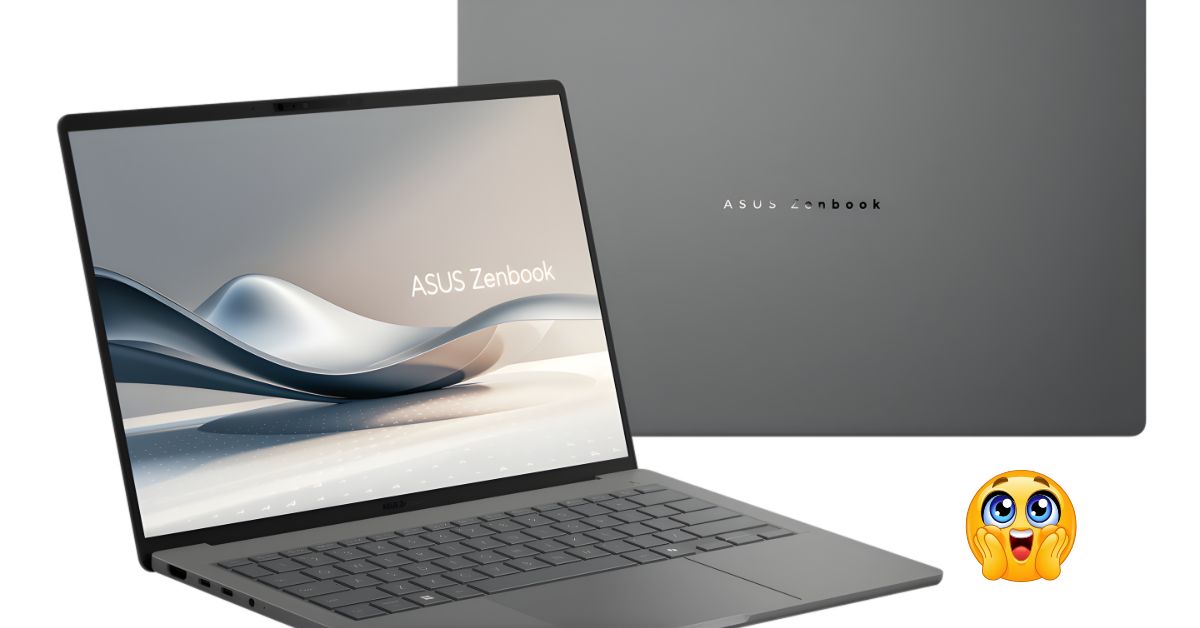
The ASUS Zenbook A14 OLED 2025 Review is an in-depth examination of a laptop that represents the ultimate convergence of specialized design, revolutionary processing architecture, and display technology. This machine, positioned as the pinnacle of the ultra-light, premium ultraportable segment, is engineered to challenge the industry benchmark set by the Apple MacBook Air, not just in performance but, crucially, in battery efficiency. The “A14” designation signifies its focus on AI-driven, all-day productivity. Built around the new ARM-based Snapdragon X Series processor, the Zenbook A14 is the definitive Copilot+ PC, promising a computing experience defined by instant responsiveness, phenomenal battery longevity, and seamless on-device AI. This comprehensive review dissects its groundbreaking Ceraluminum chassis, evaluates the revolutionary power efficiency, details the stunning OLED display technology, and confirms the highly aspirational price positioning for the Indian professional.
Core Specs and AI Architecture: The Snapdragon X Specialization
The technological core of the ASUS Zenbook A14 OLED 2025 Review subject is the new Qualcomm Snapdragon X Series processor. This adoption of the ARM architecture is the laptop’s single most significant specialization, enabling a level of performance-per-watt efficiency previously unattainable with traditional x86 chips.
The Snapdragon X Elite/Plus and NPU Power
The Zenbook A14 is offered with variants of the Snapdragon X processor, including the powerful Snapdragon X Elite (up to 12 cores) and the Snapdragon X Plus (up to 10 cores). The key performance differentiator is the integration of the Qualcomm Hexagon Neural Processing Unit (NPU), capable of delivering up to 45 TOPS (Trillion Operations Per Second). This NPU is the digital engine for the Copilot+ PC experience, enabling instantaneous, on-device AI features like Recall (a searchable visual history of everything done on the PC), Cocreator (real-time image generation in Paint), and Live Captions with real-time translation—all without relying on a cloud connection. The processor is paired with 16 GB of fast LPDDR5X onboard RAM (often soldered) and a 512 GB M.2 NVMe PCIe 4.0 SSD.
AI-Driven Workflow and Connectivity
The benefit of the integrated NPU extends beyond novel features; it ensures faster, more stable performance for everyday professional tasks. Applications optimized for the ARM architecture run natively with remarkable speed and power efficiency. The Zenbook A14 also features the latest Wi-Fi 7 connectivity and dual USB 4.0 Gen 3 Type-C ports (supporting up to $40\text{ Gbps}$ data, display output, and power delivery), ensuring it is future-proofed for high-speed docking and networking.
Display Quality: The 14-inch ASUS Lumina OLED Advantage
The visual experience of the ASUS Zenbook A14 OLED 2025 Review subject is a non-negotiable specialization, delivered by an exceptional ASUS Lumina OLED panel.
The laptop features a $14\text{-inch}$ FHD+ (1920 x 1200) or $2\text{K}$ OLED display with a desirable 16:10 aspect ratio, which provides more vertical screen space for productivity (documents, web browsing) than the traditional $16:9$ format.
Colour Accuracy and Eye Comfort
The OLED panel’s specialization lies in its perfect visual fidelity:
- Perfect Blacks and Contrast: Since OLED pixels are self-lighting, they can be turned off completely, resulting in perfect, infinite contrast ratios and true blacks, making the image pop.
- Brightness: The display achieves 400 nits typical brightness and a peak 600 nits HDR brightness (certified VESA DisplayHDR True Black 600), ensuring excellent visual punch.
- Eye Care: The panel is SGS Eye Care certified, emitting significantly lower levels of harmful blue light than conventional LCD screens, which is essential for minimizing eye strain during long working hours. Despite the high-end panel, the A14 often maintains a $60\text{ Hz}$ refresh rate in its base configuration, a deliberate choice to maximize battery life, though some high-end configurations may offer $120\text{ Hz}$.
Design and Battery Life: The Featherweight Champion
The design and endurance of the ASUS Zenbook A14 OLED 2025 Review subject are its most transformative specializations, appealing directly to the highly mobile professional.
Ceraluminum and Ultra-Lightweight Construction
The Zenbook A14 utilizes a breakthrough material called Ceraluminum for its chassis. This patented material combines the lightness of aluminum with the immense scratch-resistance and durability of ceramic. The result is a laptop that weighs under one kilogram (approximately $0.98\text{ kg}$ or $2.16\text{ lbs}$), positioning it as the world’s lightest Copilot+ PC. This featherweight construction does not sacrifice durability; the chassis is MIL-STD 810H military-grade tested against extreme temperatures, shocks, and vibrations, ensuring resilience for frequent travelers.
Read more: Lenovo LOQ Gaming Laptop
Multi-Day Battery Endurance
The high power efficiency of the Snapdragon X processor, combined with a robust $70\text{ Whrs}$ battery, delivers revolutionary battery life. This is the A14’s most critical specialization. ASUS claims up to 32 hours of continuous video playback on a single charge. In typical mixed-use scenarios (web browsing, document editing, video conferencing), the battery consistently delivers 18 to 20 hours of functional use, allowing the user to confidently leave the charger at home for multi-day trips. The laptop supports Fast Charging, achieving $60\text{ percent}$ charge in approximately 49 minutes via the USB-C port.
Performance and Usability: Trade-offs for Portability
While excelling in efficiency, the performance profile of the ASUS Zenbook A14 OLED 2025 Review subject must be contextualized within the evolving Windows-on-ARM ecosystem.
Application Compatibility and Performance
The Snapdragon X Elite processor offers powerful CPU performance for all general productivity applications (Microsoft Office, Edge, Zoom) and is highly competitive with Intel’s integrated chips and Apple’s M3 chips in single-threaded tasks. However, the integrated Qualcomm Adreno GPU is not designed for demanding professional 3D rendering or high-end AAA gaming. While many applications are now optimized to run natively on ARM, older or niche professional software may still rely on emulation (via Prism), which can introduce a performance penalty. The user must be aware that while the efficiency is best-in-class, the raw sustained power for complex, graphical workloads trails high-end x86 machines.
Usability and Ergonomics
ASUS maintains excellent ergonomics despite the thin design. The keyboard offers a comfortable $1.3\text{ mm}$ key travel and quiet actuation. The Precision Touchpad is enlarged and supports sophisticated gestures, and the webcam features an FHD camera with IR function for secure, instant login via Windows Hello facial recognition. The inclusion of a full HDMI 2.1 port and a USB-A port provides crucial dongle-free connectivity, a welcome specialization for professionals.
Pros, Cons, and Price in India
The ASUS Zenbook A14 OLED 2025 Review concludes that the laptop is the definitive choice for the ultra-mobile professional who demands both endurance and an exceptional display.
Pros (Advantages)
The major advantages are the revolutionary 18-32 hour battery life enabled by the Snapdragon X processor, the ultra-light ($0.98\text{ kg}$) and durable Ceraluminum chassis, the stunning 14-inch OLED display with $100\%$ DCI-P3 color accuracy, the advanced on-device AI capabilities (45 TOPS NPU for Copilot+ PC features), and the premium, port-rich connectivity (dual USB4, HDMI 2.1, USB-A).
Cons (Drawbacks)
The primary drawbacks are the performance trade-off in heavily threaded or graphics-intensive workloads compared to high-end Intel/AMD chips, the $60\text{ Hz}$ refresh rate on base models (limiting visual fluidity for some users), and the still-evolving software ecosystem for Windows-on-ARM, which may affect niche professional applications.
Expected Price in India
The pricing of the ASUS Zenbook A14 OLED 2025 reflects its groundbreaking technology and premium materials. The estimated Ex-Showroom Price in India for the base variant ($16\text{ GB}$ RAM, $512\text{ GB}$ SSD, Snapdragon X Plus) is highly competitive, starting around $\text{₹}83,990$ to $\text{₹}99,990$. The top-tier Snapdragon X Elite configurations are priced higher. The final On-Road Price in India for the most popular configurations is estimated to fall between $\text{₹}1,05,000$ and $\text{₹}1,35,000$, positioning it as the premier alternative to the MacBook Air for Windows users prioritizing AI, portability, and display quality.