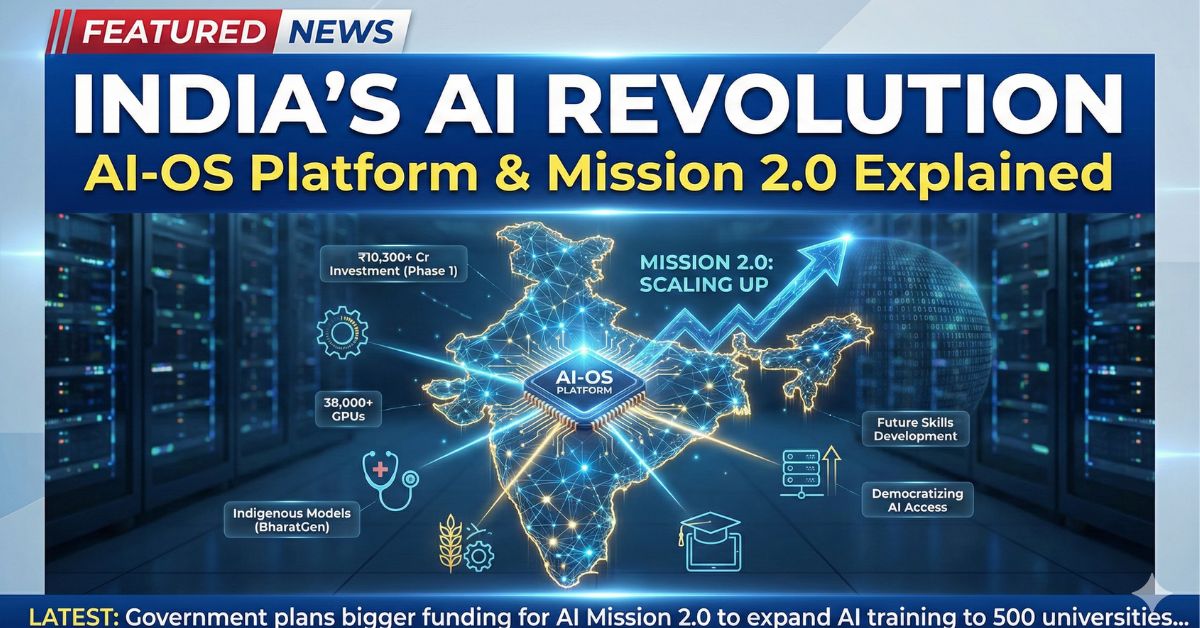
India is changing how it builds Artificial Intelligence (AI). Instead of just copying big global companies, the government has announced a unique “Indian style” of AI development. The latest Economic Survey 2025-26 and recent updates from the IT Ministry reveal a massive plan to make AI useful for the common man.
This article covers the launch of the ambitious IndiaAI Mission 2.0, the proposal for a UPI-like ‘AI-OS’ platform, and how these changes will impact jobs, students, and businesses in 2026.
What is the New ‘AI-OS’ Proposal?
Just like India revolutionized digital payments with UPI (Unified Payments Interface), the government now wants to do the same for Artificial Intelligence. The Economic Survey 2025-26 proposes an ‘AI-OS’ (Artificial Intelligence Operating System).
- Public Good: The government wants to treat AI infrastructure as a public facility, not just a tool for big private companies.
- Central Repository: This will work like a massive digital library where the government shares code, data, and tools. Developers and startups can use these resources to build their own apps without spending crores of rupees.
- Interoperability: The goal is to make sure different AI systems can “talk” to each other, making technology cheaper and faster to adopt across the country.
IndiaAI Mission 2.0: Bigger and Better
Following the success of the first phase, IT Minister Ashwini Vaishnaw has confirmed that IndiaAI Mission 2.0 will be launched soon. The government has already invested over $70 billion in computing infrastructure, and the next phase is expected to be even larger.
Key Highlights of Mission 2.0:
- Democratizing Tech: The focus is on making high-power computing (like GPUs) available to small researchers and startups, not just big tech giants.
- More Power: The current mission targets 38,000 GPUs (Graphics Processing Units) to power AI. The new mission will expand this significantly.
- Launch Timeline: The updated mission is expected to roll out within the next 5 to 6 months.
Why India is Choosing a “Bottom-Up” Strategy
While Western companies like OpenAI and Google are building massive “Foundational Models” (like ChatGPT), India is taking a “Bottom-Up” approach. This is also called Frugal AI.
Instead of spending billions on one giant brain, India wants to build thousands of smaller, smarter, and cheaper AI tools that solve specific problems.
1. Solving Real Problems
The focus is on “Application-Focused AI.” This means building tools that help a farmer check crop health or a rural doctor diagnose a disease, rather than just a chatbot that writes poems.
2. Voice-First Technology
Since many Indians prefer speaking over typing, the government is pushing for Voice-First AI systems. These tools will work in native Indian languages, allowing people in villages to access government services simply by speaking to their phones.
Key Sectors That Will Change
The new roadmap identifies specific areas where AI will have the most impact:
- Agriculture: New AI tools will help farmers with “precision farming”—telling them exactly when to water crops or use fertilizers to save money.
- Healthcare: AI will be used for early disease detection and to help doctors in remote areas make better diagnoses.
- Education: A proposed ‘Earn and Learn’ model will allow students (from Class 11 onwards) to gain credits and work experience in AI, blending classroom learning with real-world jobs.
- Finance: The RBI is guiding banks to use AI for better customer service and credit scoring, helping more people get loans who didn’t qualify before.
Impact on Jobs and Future Skills
A big concern for many is whether AI will take away jobs. The government’s stance is clear: AI should be a co-worker, not a replacement.
By 2026, AI agents are expected to act like “trainees” that need human guidance. This means the demand for skills like “Context Engineering” (teaching AI how to understand specific Indian contexts) will grow. The government is also setting up an AI Safety Institute to ensure these technologies are safe and do not spread misinformation.
Read More : Future 6G Technology Speed Explained
Frequently Asked Questions (FAQs)
Q1: What is the AI-OS mentioned in the Economic Survey?
A: It is a proposed platform by the government to make AI technology a “public good” like UPI. It allows startups and developers to access shared data and tools to build AI apps easily.
Q2: When will IndiaAI Mission 2.0 launch?
A: The IT Minister has stated that IndiaAI Mission 2.0 is expected to launch in the next 5 to 6 months (around mid-2026).
Q3: Will this AI replace jobs in India?
A: The government believes AI will work as a tool to help workers, not replace them. New roles will emerge, but workers will need to learn how to use AI tools.
Q4: What is Frugal AI?
A: Frugal AI refers to building low-cost, efficient AI models that run on simple hardware (like standard laptops or phones) to solve specific local problems, rather than expensive supercomputers.
Q5: How does this benefit students?
A: A new ‘Earn and Learn’ initiative is being planned. This will allow students to get industry experience and earn money while studying AI-related subjects from a young age.