The Indian automobile market is changing fast. Just a few years ago, buying a new car meant looking at mileage, cabin space, and a good music system. Today, terms like Artificial Intelligence (AI) and Advanced Driver Assistance Systems (ADAS) are taking over showroom conversations. But what exactly separates an AI-powered car from a normal car? If you are planning to buy a new vehicle soon, understanding this shift is crucial. This article explains the real differences, how AI works on chaotic Indian roads, and what the future holds for smart cars in the country.
What Exactly is an AI-Powered Car?
When we talk about AI in cars today, we do not mean fully driverless robots like you see in science fiction movies. In the Indian context, an AI-powered car is a vehicle equipped with smart sensors, radars, and high-definition cameras that actively assist the driver. This technology is widely known as ADAS.
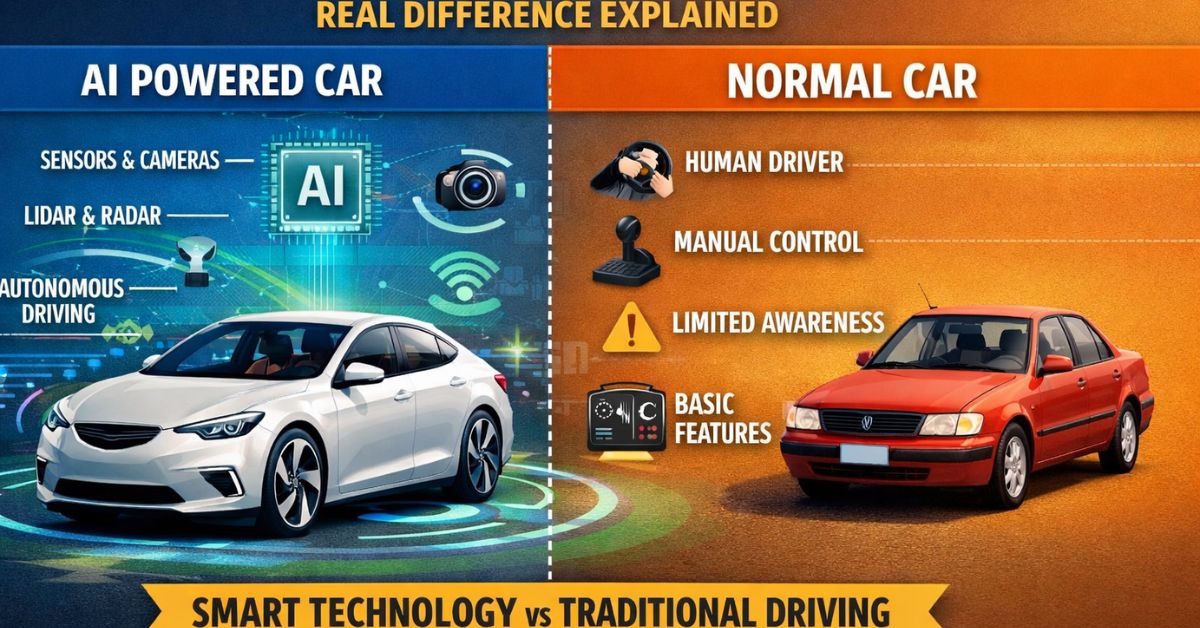
A normal car relies entirely on human senses and reflexes. The driver must look out for obstacles, apply the brakes, and keep the car in the correct lane manually. In contrast, an AI-powered car acts like an alert co-pilot. It continuously scans the road ahead, anticipates danger, and can even take corrective actions automatically to prevent an accident. Cars like the Mahindra XUV700, Tata Safari, and Hyundai Creta have brought these smart features from luxury segments into the mass market.
AI Cars vs Normal Cars: The Real Differences
The biggest difference lies in how the vehicle reacts to its surroundings. A standard car comes with passive safety features like seatbelts, airbags, and standard anti-lock braking systems. These features only protect you during or after a crash has happened. An AI-powered car uses active safety features designed to stop the crash from happening in the first place.
For example, if a pedestrian unexpectedly crosses the road and the driver fails to react in time, a normal car will simply keep moving, leading to a collision. An AI car, using Automatic Emergency Braking, will instantly detect the person and apply the brakes on its own to avoid the impact.
Another major difference is driving comfort. Normal cars require constant manual input for speed control and steering, which causes fatigue on long journeys. AI cars feature technologies like Adaptive Cruise Control and Lane Keep Assist. These systems can automatically adjust the car’s speed based on the vehicle moving in front of it and gently steer the wheel to keep the car perfectly centered in its lane.
Why This Shift Matters in India
India records one of the highest road accident rates globally. The introduction of AI and smart safety systems is a major step toward reducing crashes caused by human error, fatigue, or simple distraction. Car buyers are becoming highly safety-conscious, and manufacturers are responding by offering AI features in mid-range family cars.
Official safety frameworks are also evolving to match this trend. There are strong discussions about including ADAS testing in the upcoming Bharat NCAP safety ratings. This official push will likely force more carmakers to include AI safety technology as a standard offering rather than a premium upgrade.
The Big Challenge: Can AI Handle Indian Roads?
While the technology sounds perfect on paper, Indian roads present a highly unique challenge. In Western countries, roads have clear lane markings, structured intersections, and strict traffic compliance. In India, driving is highly unpredictable. AI systems have to deal with faded lane markings, wrong-side driving, sudden pothole dodging, and stray animals wandering onto busy highways.
Because of this daily chaos, AI systems in India are currently restricted to Level 1 and Level 2 automation. This means the driver must keep their hands on the steering wheel and their eyes on the road at all times. To solve local challenges, carmakers are actively re-engineering their AI software. They are feeding the systems millions of kilometers of local driving data so the cameras can better recognize Indian traffic patterns, auto-rickshaws squeezing through tight gaps, and complex road behaviors.
What Happens Next?
The gap in capabilities between AI cars and normal cars will only grow wider in the coming years. Industry experts predict that by 2030, a large majority of new cars sold in India will feature some level of AI assistance. As the hardware components like radars and cameras become cheaper to produce, even entry-level hatchbacks will likely get basic smart safety features.
Read More : Top Apps to Make Your Old Car Smart
Furthermore, driving an AI-powered car might soon bring financial benefits. Insurance companies are observing global trends and exploring ways to offer lower premium rates for cars equipped with ADAS. Since these intelligent vehicles are proven to be less likely to get involved in major accidents, insuring them becomes less risky for the providers.
Frequently Asked Questions (FAQs)
Is it safe to rely completely on AI cars on Indian roads?
AI features are designed to assist you, not replace you. While features like emergency braking and blind-spot monitoring are incredibly helpful, you must always pay full attention to the road. You cannot sleep or let the car drive completely by itself.
Are AI-powered cars much more expensive than normal cars?
Yes, adding high-tech radars, cameras, and processing software increases the manufacturing cost of the vehicle. However, as the technology becomes more common across brands, the price gap is slowly decreasing.
What is the exact difference between ADAS and fully autonomous cars?
ADAS requires a human driver to be in control at all times while the car provides assistance and warnings. Fully autonomous cars drive themselves without any human input, but these are currently not legal or practically available for public use in India.
Can AI cars detect stray animals like cows and dogs?
Modern AI systems in premium Indian cars are constantly being trained to recognize large stray animals. However, sudden and erratic movements by animals can still confuse the software, which is why human alertness remains absolutely necessary.
Do I need a special driving license to drive an AI-powered car?
No, you do not need a special license. Any valid Indian driving license for light motor vehicles is sufficient, as you are still the primary driver operating the vehicle.