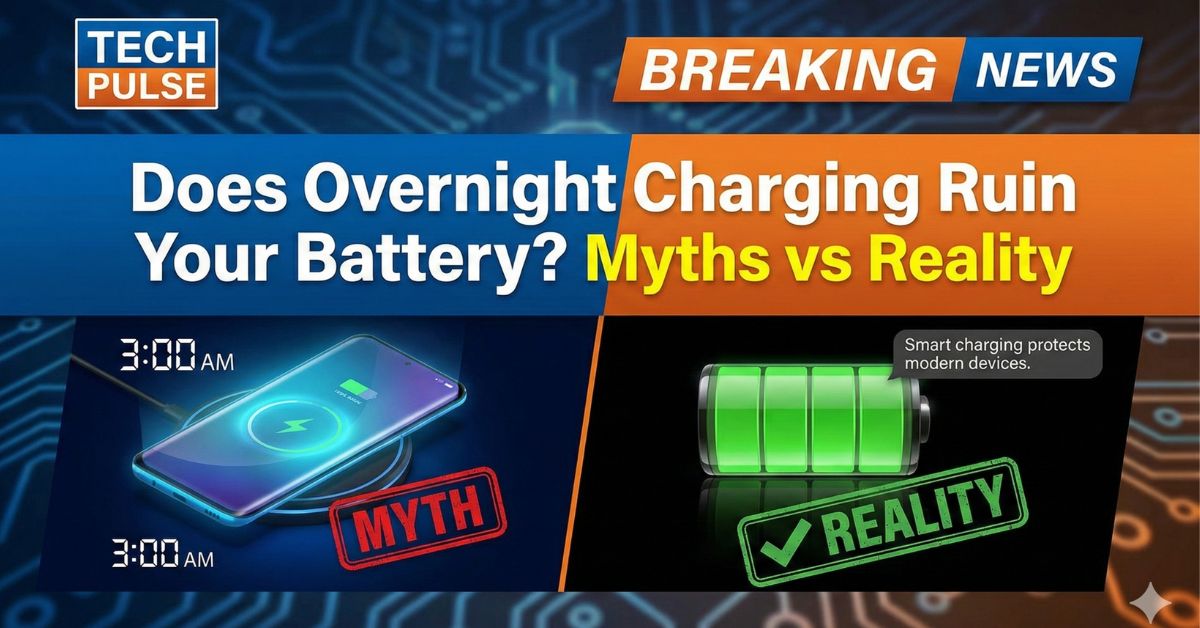
We all do it. You crawl into bed, scroll through Instagram for a few minutes, plug your phone into the charger, and go to sleep. It is the most convenient time to charge. But for years, we have heard scary warnings: “Don’t leave it plugged in all night! It will overcharge! It will explode!”
Is this true in 2026, or is it just an old myth?
With smartphones getting expensive and battery life becoming a priority for Indian users, it is time to clear the confusion. Here is the expert truth about overnight charging, how modern batteries work, and what actually damages your phone.
The Short Answer: No, It Won’t Explode
Let’s start with the good news: You cannot “overcharge” a modern smartphone.
Whether you have a budget Android phone or the latest iPhone, your device is smarter than you think. Modern phones use Lithium-ion batteries with a built-in safety chip called a BMS (Battery Management System).
Once your battery hits 100%, the BMS completely cuts off the incoming power. Your phone effectively stops charging. It doesn’t matter if you leave it plugged in for 8 hours or 8 days; the battery will not take in more power than it can handle. The risk of the battery exploding simply because it was plugged in overnight is zero, provided you are using a genuine charger.
But… Is It Good for the Battery?
While your phone won’t explode, leaving it at 100% all night is not “healthy” for the battery in the long run. Here is why.
1. The “Trickle Charge” Problem
Even though the power cuts off at 100%, your phone still consumes a little bit of energy in the background (for Wi-Fi, notifications, or app updates). When the battery drops to 99%, the charger wakes up and tops it back to 100%.
This process repeats throughout the night. It is called “trickle charging.” While it keeps your phone full, it also keeps the battery temperature slightly higher than normal.
2. High Voltage Stress
Think of your battery like a rubber band. When it is at 100%, the rubber band is stretched to its limit. If you keep it stretched tight for 8 hours every night, eventually, the rubber band loses its elasticity.
Similarly, keeping a Lithium-ion battery at 100% places it under “voltage stress.” Over 2-3 years, this habit can reduce your battery health faster than if you unplugged it earlier.
The Real Enemy is Heat (Especially in India)
In a country like India, where summer temperatures can easily cross 40°C, heat is the biggest killer of batteries—not the charging itself.
If you charge your phone overnight and keep it under your pillow or on a soft mattress, the heat cannot escape.
- The Result: The battery cooks itself.
- The Damage: High heat permanently reduces the capacity of Lithium-ion cells.
If you must charge overnight, always keep the phone on a hard, cool surface like a table or the floor. Never cover it.
The “Smart” Solution: Optimized Charging
Phone manufacturers know that people love overnight charging. That is why they have introduced software features to solve the problem.
- For iPhone Users: Apple has “Optimized Battery Charging.” Your iPhone learns your sleep cycle. It charges to 80% and pauses. It only finishes the last 20% right before you usually wake up.
- For Samsung/Android Users: Look for “Adaptive Charging” or “Protect Battery” in your settings. Some Samsung phones allow you to limit charging to strictly 80% or 85%, which is the best way to extend battery lifespan by years.
5 Golden Rules for Indian Smartphone Users
To keep your battery healthy for 3–4 years, follow these simple habits:
- Follow the 20-80% Rule: Try to charge when your phone drops to 20% and stop when it hits 80%. This is the “sweet spot” for battery chemistry.
- Remove Thick Cases: If you use a heavy protective case, remove it while charging. Cases trap heat, which damages the battery.
- Use BIS-Certified Chargers: In India, many cheap roadside chargers lack safety fluctuations protection. Always use the original cable or a BIS-certified adapter.
- Avoid “Fast Charging” Overnight: If you are sleeping for 7 hours, you don’t need a 100W super-fast charger. A slow charger produces less heat and is better for overnight use.
- Don’t Let it Die: Letting your phone drain to 0% (switch off) is actually worse than charging it to 100%. Avoid deep discharge.
Frequently Asked Questions (FAQs)
Q1: Will overnight charging make my phone battery last less time during the day?
A: Not immediately. However, over 2-3 years, the battery’s total capacity will drop faster than normal. You might notice your phone drains quicker a few years down the line.
Q2: Is fast charging bad for battery health?
A: Fast charging itself is fine, but the heat it produces is bad. If your phone gets very hot while fast charging, it can damage the battery.
Q3: Can I use any charger for my phone?
A: You should only use a charger that matches your phone’s power rating and is certified (like BIS in India). Cheap, unbranded chargers can bypass safety circuits and damage your phone.
Q4: Should I charge my new phone to 100% before using it?
A: No, this is an old rule for older battery types. Modern Lithium-ion batteries work best right out of the box and do not need to be fully charged before first use.
Q5: Does “Dark Mode” save battery?
A: Yes, if your phone has an OLED or AMOLED screen (common in Samsung, OnePlus, and iPhones). Dark mode turns off black pixels, saving significant power.