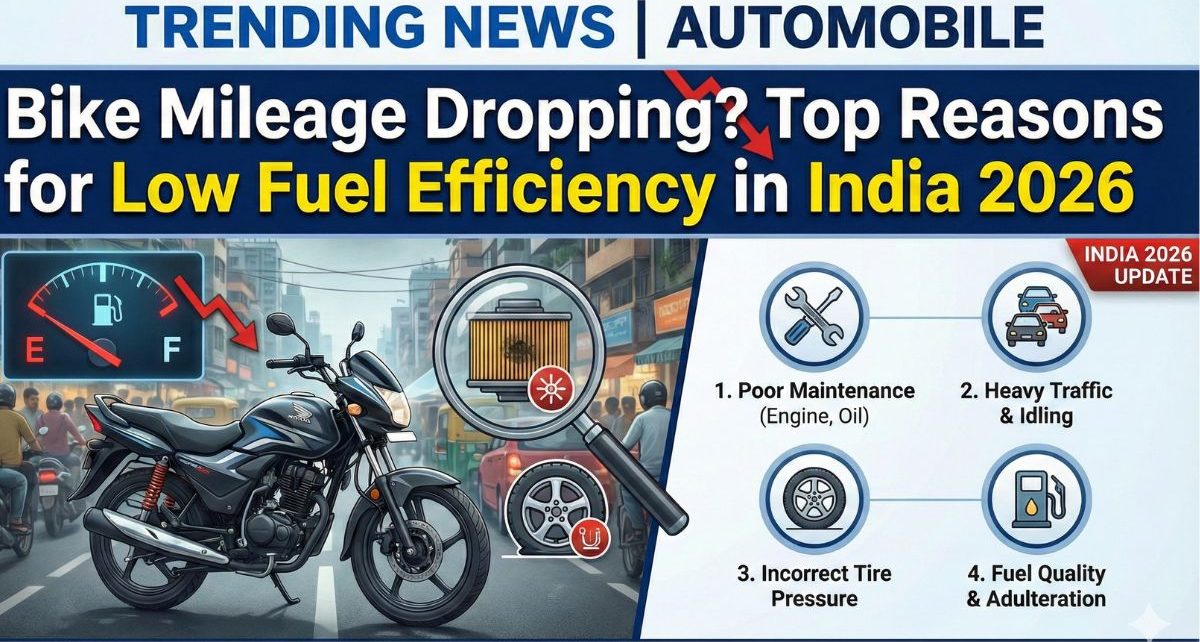
Rising fuel prices in India have made fuel efficiency a top priority for every vehicle owner. Whether you navigate the bumper-to-bumper traffic of Mumbai or the open highways of Rajasthan, a sudden drop in mileage can be frustrating and expensive. Many drivers often blame the fuel quality at the petrol pump, but the truth is usually hidden under the hood or in the way we drive.
This guide explores the most common reasons why your car or bike might be consuming more fuel than usual and offers practical solutions to help you get the best out of every litre.
Poor Driving Habits and “Clutch Riding”
One of the most significant factors affecting fuel economy is the person behind the wheel. In India, many drivers have a habit of “riding the clutch”—keeping the left foot lightly pressed on the clutch pedal while driving. This not only wears out the clutch plates prematurely but also causes the engine to rev higher than necessary, wasting fuel.
Similarly, aggressive driving—characterized by rapid acceleration and sudden braking—is a major culprit. When you floor the pedal to overtake in city traffic, the engine requires a massive burst of energy. Smooth, gradual acceleration and maintaining a steady speed between 50 kmph and 70 kmph can improve your mileage by up to 15%.
Incorrect Tyre Pressure
Your tyres are the only point of contact between your vehicle and the road. When tyre pressure is lower than the manufacturer’s recommended level, the “contact patch” with the road increases. This creates more rolling resistance, meaning the engine has to work much harder to move the vehicle forward.
Checking your tyre pressure at least once every two weeks is a simple yet effective way to save fuel. It is also important for bike owners to ensure the chain is properly lubricated; a dry or tight chain creates mechanical drag that mimics the effect of low tyre pressure.
Clogged Air Filters and Dirty Sensors
Modern engines need to “breathe” to burn fuel efficiently. Because Indian roads are often dusty, air filters tend to get clogged faster than the service manual might suggest. A dirty filter restricts airflow, forcing the engine to inject more fuel to compensate for the lack of oxygen, which leads to “rich” combustion and poor mileage.
In newer cars, the Oxygen (O2) Sensor plays a vital role. It monitors the exhaust gases and tells the car’s computer how much fuel to use. If this sensor is covered in soot or is malfunctioning, it might send wrong signals, causing the engine to burn significantly more fuel than required.
The Impact of Fuel Quality and E20 Blending
Fuel adulteration remains a concern in certain parts of India. Low-quality or contaminated petrol can lead to incomplete combustion and carbon buildup in the engine. Furthermore, the Indian government has transitioned to E20 fuel (20% Ethanol blend). While Ethanol is better for the environment, it has a slightly lower energy density than pure petrol, which can result in a minor (3–5%) drop in mileage for older vehicles not optimized for this blend.
Overloading and Aerodynamics
Every extra kilogram in your boot or on your bike’s pillion seat requires more energy to move. Many Indian car owners use their vehicles as “mobile storage,” carrying heavy tools, spare parts, or luggage unnecessarily. Additionally, adding bulky aftermarket accessories like heavy crash guards or roof racks can ruin the vehicle’s aerodynamics, increasing wind resistance and fuel consumption at higher speeds.
Frequently Asked Questions (FAQs)
Q1: Does using the Air Conditioner (AC) always reduce mileage?
Yes, the AC compressor is powered by the engine. In city traffic, using the AC can reduce mileage by 10% to 20%. However, on highways, it is better to use the AC with windows closed than to drive with windows open, as open windows create “drag” that slows the car down.
Q2: My new car is giving low mileage. Is it a defect?
Not necessarily. Brand-new engines have very tight components. It usually takes 3,000 to 5,000 km (the “run-in” period) for the engine parts to settle and reach peak efficiency. You should see an improvement after the first or second service.
Q3: How often should I check my bike’s air filter in India?
Given the dusty conditions in many Indian cities, it is wise to inspect the air filter every 2,000–3,000 km. If you live in a particularly dusty area, you might need to clean or replace it more frequently than the standard service interval.
Q4: Can wheel alignment affect fuel consumption?
Absolutely. If your wheels are not aligned, they are essentially fighting against each other. This creates friction and forces the engine to burn more fuel to maintain a straight line.
Q5: Does “Eco Mode” really work?
Yes, most modern Indian cars come with an Eco Mode that dulls throttle response and optimizes gear shifts to ensure the engine operates in its most efficient range.