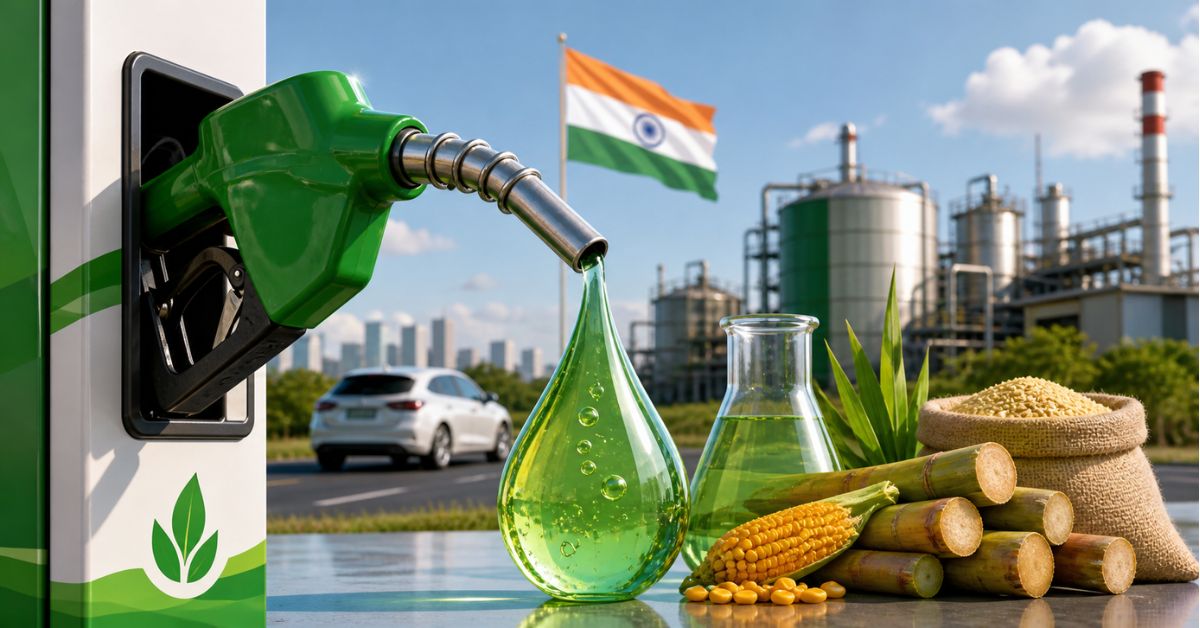
India’s Petrol Ethanol Blending Demand 2026 has become a major news topic because the country has moved from a target-based ethanol plan to a wider fuel transition. From April 1, 2026, oil companies have been directed to sell petrol blended with up to 20% ethanol and with a minimum Research Octane Number, or RON, of 95 across states and Union Territories.
The bigger story is not only E20 petrol. India is now looking at higher ethanol blends such as E85 and E100, which could create a new demand cycle for ethanol producers, farmers, oil companies, and automobile makers. The shift matters because it can reduce crude oil imports, support domestic biofuel production, and change how petrol vehicles are designed in India.
What Happened?
The Ministry of Petroleum and Natural Gas issued a Gazette notification on February 17, 2026, directing oil companies to sell ethanol-blended motor spirit with ethanol content up to 20%, as per Bureau of Indian Standards specifications, and with minimum RON 95. The notification came into force on April 1, 2026.
Soon after this E20 rollout, the government also moved towards higher blends. Reuters reported that India proposed amendments to the Central Motor Vehicles Rules to allow higher ethanol-blended fuels, including E85 and E100, for vehicles. The draft rules were opened for public comments before a final decision.
This means E20 is already the main national direction, while E85 and E100 are still at the policy proposal stage. It does not mean every petrol vehicle can immediately use E85 or E100.
Why Petrol Ethanol Blending Demand Is Rising In 2026
The main reason is simple: when petrol across India moves towards E20, Petrol Ethanol Blending Demand 2026 becomes much larger and more stable. Under E20, petrol contains up to 20% ethanol and 80% petrol. This creates regular demand from oil marketing companies.
Mint reported that India produced about 20 billion litres of ethanol as of March 2026, while demand under the current 20% blending mandate was about 11 billion litres. This shows that India has built large ethanol capacity, but part of that capacity may remain underused if demand does not move beyond E20.
The USDA Foreign Agricultural Service report said India achieved the E20 target in June 2025, five months ahead of schedule. It also said India had reached a national average ethanol blending rate slightly above 20% in January 2026, with more than 10.4 billion litres of ethanol blended into petrol.
Petrol demand itself is also important. PPAC’s revised estimate for FY 2025-26 listed Motor Spirit, or petrol, at 42,534 thousand metric tonnes. As petrol use grows, the volume of ethanol needed for blending also rises.
Background: How India Reached E20
India’s Petrol Ethanol Blending Demand 2026 Blended Petrol programme has been running for years, but it moved faster after the government advanced the 20% blending target from 2030 to Ethanol Supply Year 2025-26. PIB said oil marketing companies had achieved average ethanol blending of 19.05% as of July 31, 2025, and 19.93% in July 2025.
The government has used several steps to support ethanol supply. These include expanding feedstock options, supporting maize production near ethanol plants, allowing surplus FCI rice for ethanol, permitting sugar diversion, reducing GST on ethanol for the blending programme, and supporting ethanol production infrastructure.
In simple words, India did not reach E20 only by using sugarcane. The ethanol supply base has expanded to include sugarcane, maize, damaged food grains, and surplus rice. This has made production more flexible, but it has also created new questions about crop prices, food supply, and regional logistics.
Why The Government Is Looking Beyond E20
The move towards E85 and E100 is linked to two issues: energy security and ethanol capacity. India imports a large share of its crude oil needs, so blending more domestic ethanol can reduce pressure on imports. The government also wants to give ethanol producers a larger market.
The proposed Central Motor Vehicles Rule changes would formally include higher ethanol fuels such as E85 and E100 in the vehicle emission testing and certification system. ETAuto reported that the draft also proposes updating fuel references from E10/E to E10/E20 and replacing biodiesel references from B10 to B100.
This is important because fuel policy and vehicle rules must move together. Higher blends need compatible engines, fuel systems, testing rules, storage systems, and clear labelling for consumers.
Impact On Vehicle Owners In India
For most consumers, the first question is about mileage and vehicle safety. The government has responded to concerns about E20 and said biofuels are part of India’s cleaner fuel transition. PIB also cited a NITI Aayog study saying sugarcane-based ethanol and maize-based ethanol have lower life-cycle greenhouse gas emissions than petrol.
Still, vehicle compatibility should not be ignored. NITI Aayog’s ethanol roadmap said the compatibility of a vehicle with E20, E85, E100 or other ethanol levels should be defined by the vehicle manufacturer and displayed clearly on the vehicle.
So, vehicle owners should check the owner’s manual, manufacturer guidance, or fuel label before using any higher blend. E20 may be part of the national fuel supply, but E85 or E100 would need flex-fuel vehicles or vehicles specifically designed for such blends.
Impact On Farmers And Ethanol Producers
The ethanol push can support farmers by creating demand for crops used to make ethanol. Sugar mills and grain-based distilleries can also benefit from long-term ethanol supply contracts.
But there are risks too. The USDA report said India’s rapid ethanol expansion has created challenges, including feedstock supply volatility and idle production capacity. It also noted concerns around corn prices and the need for clearer blending targets beyond E20.
This means the ethanol story is not only about fuel pumps. It is also about agriculture planning, crop prices, sugar stocks, maize supply, rice allocation, and rural income.
Why This Matters For India’s Economy
Petrol ethanol blending demand in 2026 matters because it connects three major areas of the economy: energy, farming, and manufacturing.
For the energy sector, ethanol blending can reduce part of the need for imported petrol components. For farmers, it can create another market for sugarcane, maize, and other feedstocks. For the auto industry, it can push demand for E20-compatible and flex-fuel vehicles.
At the same time, the government will need to balance fuel goals with food security, crop pricing, and consumer concerns. If ethanol demand rises too fast without stable supply planning, it can create pressure in agricultural markets. If vehicle rules move faster than vehicle readiness, consumers may face confusion.
What Happens Next?
The next step is the final decision on the draft rules for higher ethanol blends. The draft rules for E85 and E100 are open for public comments, and the government will take a final view after reviewing feedback.
For now, E20 remains the main national fuel direction. A national move to E85 or E100 would need more policy action, more flex-fuel vehicles, fuel pump readiness, safety standards, and consumer awareness.
There is also market talk about blends beyond E20, but a verified national E25 or E30 mandate has not been officially confirmed in the sources checked. Until there is a formal government notification, such claims should be treated as possible policy discussion, not final policy.
Official Updates To Watch
The most important updates to watch are fresh notifications from the Ministry of Petroleum and Natural Gas, draft or final rules from the Ministry of Road Transport and Highways, PPAC petrol consumption data, and BIS fuel quality standards.
Read More : Hyundai Ioniq 5 Launched in India 2026
Consumers should also watch announcements from car and two-wheeler makers because vehicle compatibility will be a key part of any move beyond E20.
FAQs(Petrol Ethanol Blending Demand 2026)
What is E20 petrol?
E20 petrol is petrol blended with up to 20% ethanol. In India, oil companies have been directed to sell ethanol-blended motor spirit with up to 20% ethanol and minimum RON 95 from April 1, 2026.
Why is petrol ethanol blending demand rising in 2026?
Demand is rising because E20 has become the main national blending direction. When petrol sales grow, the ethanol needed for blending also grows.
Are E85 and E100 available for all vehicles now?
No. E85 and E100 are part of a draft rule proposal for higher ethanol fuels. These fuels would need compatible vehicles and final regulatory approval before wider use.
Will E20 damage my vehicle?
Vehicle compatibility depends on the manufacturer and model. The safest step is to check the vehicle manual or official manufacturer guidance. Higher blends like E85 and E100 should only be used in vehicles designed for them.
Does ethanol blending help India?
Ethanol blending can help reduce crude oil import dependence, support domestic ethanol producers, and create demand for farm-based feedstocks. But it also needs careful planning to avoid pressure on food crops, prices, and vehicle users.
What is the next big update?
The next key update will be whether the government finalises rules for higher ethanol blends such as E85 and E100 after public comments.