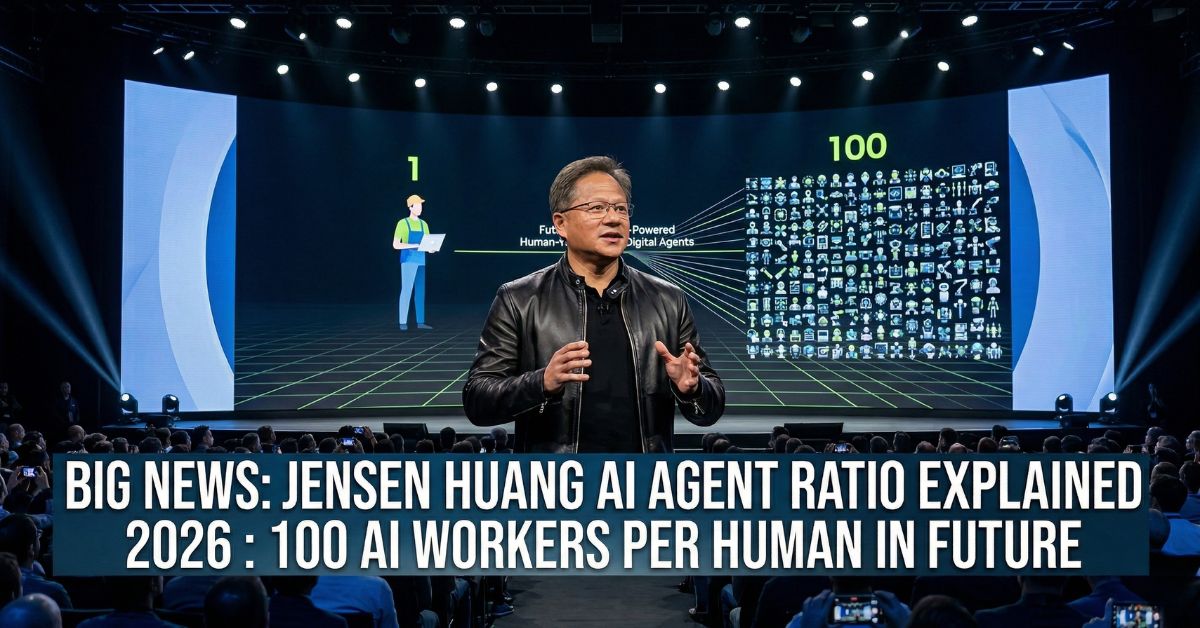
The future of work may look very different than today. Nvidia CEO Jensen Huang AI Agent Ratio has made a bold prediction about artificial intelligence (AI) that is now trending globally. He said that in the coming years, companies could have around 100 AI agents working alongside every human employee.
This statement has sparked discussions across the tech world, including India. In this article, we explain what Huang actually said, what AI agents are, why this matters, and how it could impact jobs and businesses.
What Did Jensen Huang AI Agent Ratio ?
At Nvidia’s GTC 2026 event, Jensen Huang shared his vision of the future workplace. He said that in about 10 years, Nvidia could have:
- Around 75,000 human employees
- Working with 7.5 million AI agents
This means a 100:1 ratio of AI agents to humans.
According to Huang, these AI agents will not replace humans completely. Instead, they will support workers by handling routine and repetitive tasks.
What Are AI Agents and How Are They Different?
AI agents are not just chatbots like ChatGPT. They are more advanced systems that can:
- Plan tasks
- Take actions automatically
- Work continuously without human input
Unlike traditional AI tools, agents can act like digital workers. For example, they can manage emails, analyze data, write code, or even run experiments independently.
Experts say this shift marks a new phase of AI—from just generating content to actually doing work.
Why Is This Prediction Important?
Huang’s statement is not just a theory. It reflects a bigger trend happening in the tech industry:
1. AI is Becoming a “Workforce Multiplier”
AI agents can work 24/7 and handle multiple tasks at once. This can make employees much more productive.
2. Companies Are Investing Heavily in AI
Many companies are increasing their AI budgets in 2026 and beyond, focusing on automation and efficiency.
3. AI Usage Is Becoming a Performance Metric
Huang even suggested that employees should actively use AI tools. Low usage could mean lower productivity in the future.
The Bigger Picture: AI Agents Everywhere
Huang has also said that every company needs an AI agent strategy, calling it “the new computer.”
This means AI agents could soon become as common as computers or smartphones in workplaces.
At the same time, governments and companies are also raising concerns about security and misuse, especially with powerful tools like OpenClaw.
Impact on Jobs in India
India is one of the fastest-growing tech markets, so this trend matters a lot.
Opportunities:
- Increased demand for AI-skilled professionals
- Faster business operations in IT, finance, healthcare
- Growth in startups using AI automation
Challenges:
- Routine jobs may reduce
- Need for reskilling and upskilling
- Higher competition in tech roles
Experts believe that AI will change jobs, not eliminate all of them. Workers who adapt to AI tools will benefit the most.
Why This Matters for the Future
The idea of 100 AI agents per person may sound extreme today. But it shows how fast AI is evolving.
Huang’s vision suggests:
- Work will become more automated
- Humans will focus on creative and strategic tasks
- AI will handle repetitive and time-consuming work
In simple terms, humans may become “managers” of AI systems rather than doing every task themselves.
Read More : How AI Deep Learning Works: आसान और Best Guide (2026)
What Happens Next?
In the coming years, we can expect:
- More AI tools entering workplaces
- Companies building their own AI agents
- Governments creating rules for safe AI use
- Increased demand for AI education and training
The real test will be how businesses and workers adapt to this change.
FAQs(Jensen Huang AI Agent Ratio)
1. What is the AI agent ratio 100:1?
It means 100 AI agents could work alongside one human employee in the future.
2. Will AI agents replace human jobs?
Not completely. They will mostly handle repetitive tasks and support humans.
3. What did Jensen Huang predict for 2026?
He predicted rapid growth of AI agents and their major role in workplaces.
4. What are AI agents used for?
They can automate tasks like coding, data analysis, customer support, and more.
5. Is this trend relevant for India?
Yes, especially for IT, startups, and digital businesses in India.