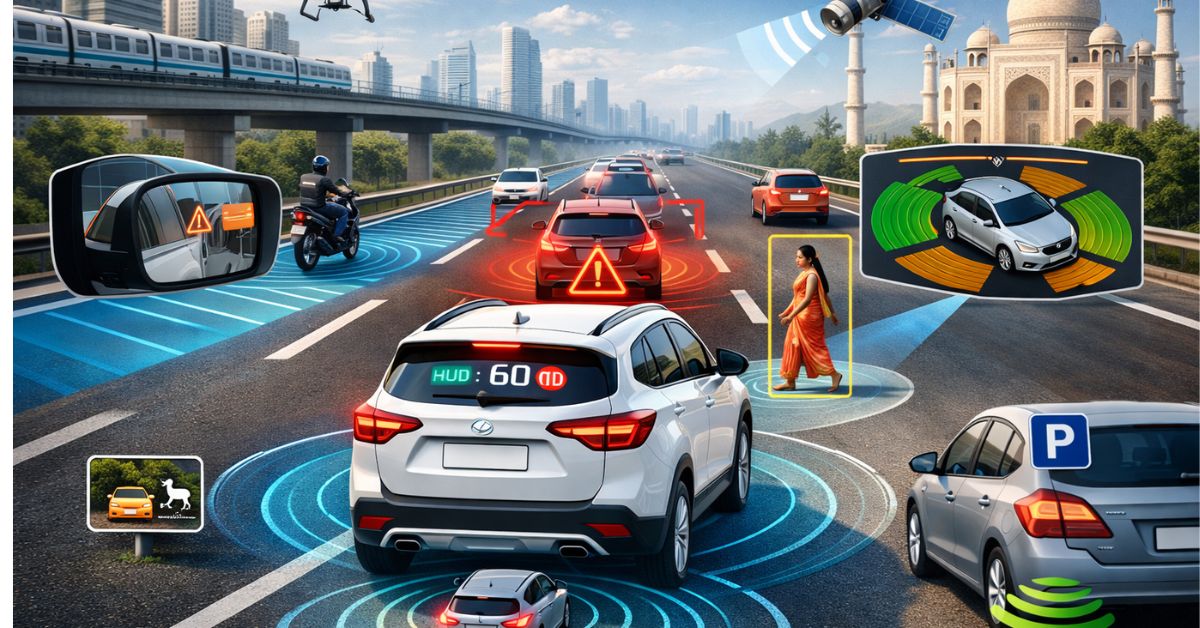
Have you recently heard car companies talking about ADAS and wondered what it actually means? You are not alone. As more car buyers in India look for safer vehicles, Advanced Driver Assistance Systems, or ADAS, have become a huge buzzword. While many people search for “ADAS technology in cars explained in Hindi” to understand this complex tech, the simple truth is that it is a smart safety net designed to protect you. This article explains what ADAS is, how it works, and why it is changing the way we drive on Indian roads.
What is ADAS Technology in Simple Words?
Advanced Driver Assistance Systems (ADAS) are a group of smart safety features built into modern cars. Think of ADAS as an invisible co-driver that is always paying attention to the road. Using a network of cameras, radar, and sensors placed around the car, the system constantly monitors your surroundings.
When the system detects a potential danger, like a sudden stop by the car ahead or a pedestrian stepping onto the road, it reacts instantly. It can alert the driver through warning sounds or dashboard lights. In more advanced setups, the car can even take action on its own, such as applying the brakes or gently steering the vehicle back into the correct lane. The main goal of this technology is to reduce human error, which is the leading cause of road accidents worldwide.
Key Features You Will Find in ADAS Cars
Even though there are dozens of different sensors in a modern vehicle, the most common ADAS features in Indian showrooms today can be grouped easily.
First, there are collision avoidance features. Forward Collision Warning tells you if you are about to hit something, while Autonomous Emergency Braking actually steps on the brakes for you if you do not react in time.
Then, there are lane and blind-spot helpers. Lane Departure Warning beeps if your car starts drifting out of its lane without an indicator. Lane Keeping Assist will actively steer you back to the center. Blind Spot Detection is especially useful, alerting you if a vehicle is hiding just outside your mirror’s view.
Finally, there are convenience features like Adaptive Cruise Control. Unlike standard cruise control that just holds a steady speed, the adaptive version slows down and speeds up to match the traffic ahead of you. This makes highway driving much less tiring.
Why ADAS Matters for Indian Roads
Indian traffic is famous for being chaotic and unpredictable. You constantly deal with mixed traffic, sudden lane changes, stray animals, and unclear road markings. Because of this, ADAS software in India has to be specially tuned to understand local driving behavior rather than just relying on standard Western traffic rules.
The impact of this technology in India is massive. It acts as a crucial safety barrier that prevents crashes before they happen. For highway drivers, it drastically reduces the fatigue of long journeys. In crowded cities, the sensors help avoid minor bumps and scrapes. Over time, as more cars use these safety features, the overall accident rate on our highways is expected to drop significantly.
Which Indian Cars Offer ADAS in 2026?
A few years ago, ADAS was only found in luxury cars. Today, it has entered the mass market. Car manufacturers are offering Level 1 and Level 2 ADAS at very competitive prices.
Read More : Tata Punch EV 2026 Launched
Mahindra has been a major player, offering Level 2 ADAS in popular models like the XUV700, the Thar Roxx, and the affordable XUV 3XO. Honda has made it highly accessible by including their “Honda Sensing” suite in the Elevate SUV, the City sedan, and even in the newly updated Amaze. Hyundai and Kia also offer robust Level 2 systems in their top-selling cars, including the Creta, Verna, Seltos, and Syros. Similarly, Tata Motors has equipped the Harrier, Safari, and the new Curvv with advanced safety tech.
What Happens Next?
The future of car safety in India looks very promising. According to recent industry forecasts, ADAS adoption is expected to grow rapidly, potentially reaching over sixty percent of new car sales by 2035.
Furthermore, the Indian government is taking road safety very seriously. Starting in April 2026, ADAS features are mandated for commercial vehicles. As technology costs continue to drop and software gets better at reading Indian roads, we will likely see ADAS become a standard feature in almost every new car, much like airbags and anti-lock brakes are today.
Frequently Asked Questions (FAQs)
What is the difference between Level 1 and Level 2 ADAS?
Level 1 ADAS can control either the steering or the speed of the car, but not both at the same time. Level 2 ADAS can control both steering and speed simultaneously, like keeping the car in its lane while automatically managing the distance from the car ahead.
Can ADAS drive the car for me?
No, ADAS does not make your car fully self-driving. It is an assistance system meant to help you. You must always keep your hands on the steering wheel and your eyes on the road.
Is ADAS useful in heavy Indian city traffic?
Yes, features like blind-spot monitoring, rear cross-traffic alert, and low-speed emergency braking are very helpful in tight, congested city traffic. However, adaptive cruise control is generally better suited for open highways.
Can I turn off ADAS features if I want to?
Yes, most car manufacturers allow you to turn off specific ADAS features or adjust their sensitivity through the car’s touchscreen menu if you find them too distracting.
Does installing ADAS make a car much more expensive?
While it used to be a costly add-on, localized manufacturing and better technology have brought prices down. Today, you can buy a car with advanced safety features for around ten lakh rupees in India.