Imagine downloading 100 movies in just one second. That is the promise of 6G. While India is still expanding its 5G networks, the race for the next generation of mobile internet—6G—has already begun.
The future of the internet is not just about faster reels or video calls. It is about connecting machines, holograms, and digital worlds instantly. India has set a bold target to become a global leader in this technology by 2030.
This article explains what 6G speed really means, how it compares to 5G, and when you can expect it on your phone in India.
What is 6G and How Fast Will It Be?
6G stands for the Sixth Generation of wireless mobile technology. It is the successor to 5G. While 5G focused on connecting people and the Internet of Things (IoT), 6G focuses on connecting intelligence—merging the physical and digital worlds.
The Speed Numbers
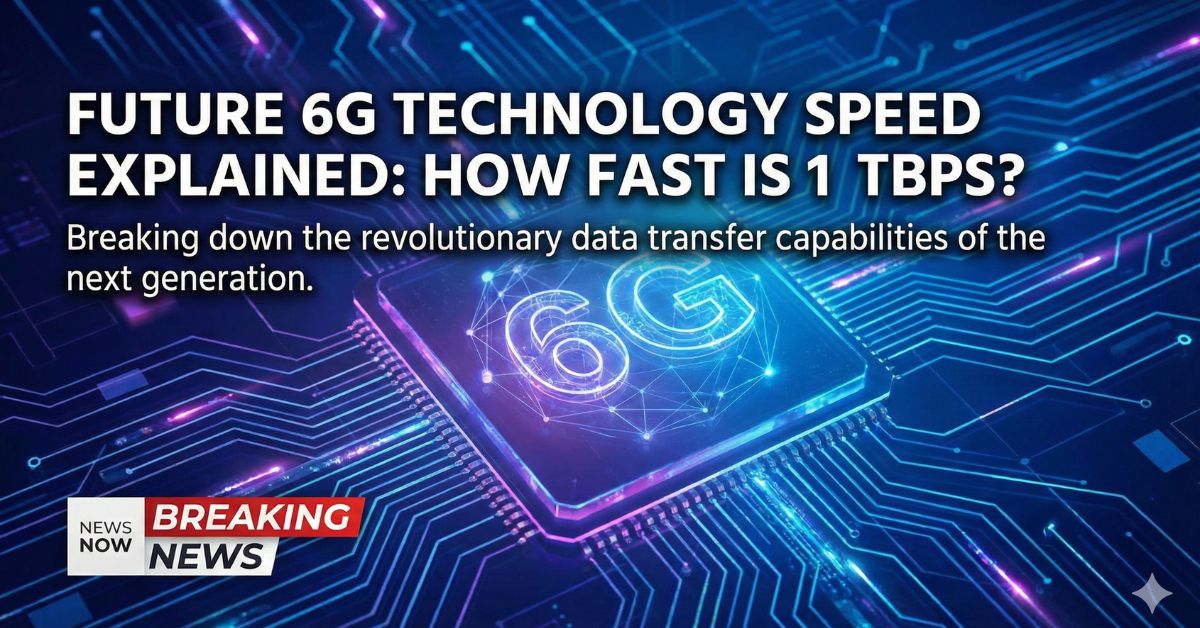
The theoretical top speed of 6G is expected to be 1 Terabit per second (Tbps).
To put this in simple terms:
- 1 Tbps = 1,000 Gigabits per second (Gbps).
- This makes 6G roughly 100 times faster than the peak speed of 5G.
- Recent lab tests globally have already achieved speeds around 900 Gbps, proving this technology is possible.
Zero Lag (Latency)
Speed isn’t just about downloading files. It is also about “latency”—the delay between tapping a button and seeing the action happen.
- 4G Latency: ~50 milliseconds (ms)
- 5G Latency: ~1–5 ms
- 6G Latency: Less than 1 microsecond (0.001 ms).This means communication will happen almost instantly, faster than the human brain can process.
6G vs. 5G: The Main Differences
Many users feel 5G is already fast enough. So, why do we need 6G? Here is a simple comparison:
| Feature | 5G Network | 6G Network |
| Peak Speed | Up to 10–20 Gbps | Up to 1,000 Gbps (1 Tbps) |
| Latency (Delay) | 1 millisecond | Microseconds (near zero) |
| Frequency | GHz waves (Millimeter wave) | THz waves (Terahertz) |
| Device Density | 1 million devices per sq. km | 10 million devices per sq. km |
| Main Use | Fast internet, IoT, 4K video | Holograms, Digital Twins, AI |
India’s “Bharat 6G Vision”
India does not want to just buy technology from other countries anymore; it wants to create it. In 2023, Prime Minister Narendra Modi released the official “Bharat 6G Vision” document.
Key Goals for India:
- Launch Date: India aims to launch 6G services by 2030.
- Patents: The government targets holding 10% of all global 6G patents.
- Research: A body called the Bharat 6G Alliance has been formed. It brings together the government, telecom companies (like Jio, Airtel, Vi), and tech startups to build this technology locally.
- Testing: 6G test beds are already being set up in academic institutes to experiment with these high speeds.
Why 6G Matters for You
You might think, “I don’t need 1000 Gbps to watch YouTube.” You are right. But 6G is built for things we haven’t fully seen yet.
1. Holographic Calls
Video calls (Zoom/WhatsApp) will feel old. With 6G, you could project a 3D hologram of a friend or colleague right into your living room.
2. Remote Healthcare
Because there is zero lag, a top heart surgeon in Mumbai could operate on a patient in a village using robotic arms controlled over the internet. The robot would move instantly as the doctor moves their hands.
3. Smart Cities & Factories
6G will allow millions of sensors to work together. Traffic lights, cars, and roads will talk to each other perfectly to stop accidents and traffic jams.
4. Integration with Satellites
6G is designed to work seamlessly with satellites (Non-Terrestrial Networks). This means you could get high-speed internet even in the middle of the ocean, deep forests, or on flights.
The Challenges Ahead
While the speed sounds amazing, there are big hurdles before 6G becomes reality:
- Infrastructure: 6G uses very high-frequency waves (Terahertz). These waves carry huge data but cannot travel far and get blocked by walls easily. We will need many small towers/antennas everywhere.
- Cost: Building a new network is expensive. Telecom companies are still recovering the costs of 5G.
- Devices: Your current phone, and even today’s best 5G phones, will not work with 6G. We will need entirely new devices.
What Happens Next?
Currently, we are in the Research & Standardization phase.
- 2024–2025: Scientists and companies are agreeing on technical rules (standards) for 6G.
- 2027–2028: We will likely see the first real-world demonstrations.
- 2030: Commercial rollout is expected to begin in India and globally.
Official Update: The Department of Telecommunications (DoT) is actively funding research projects to ensure India is “6G Ready” before the rest of the world.
Read More : How Indian SMEs Are Using AI in 2026
Frequently Asked Questions (FAQs)
Q1: How much faster is 6G than 5G?
A: 6G is expected to be about 100 times faster than 5G. While 5G peaks around 10-20 Gbps, 6G could reach up to 1,000 Gbps (1 Terabit).
Q2: When will 6G come to India?
A: According to the “Bharat 6G Vision” document, India plans to roll out 6G services commercially by the year 2030.
Q3: Do I need a new phone for 6G?
A: Yes. Just like 4G phones cannot use 5G networks, you will need a new 6G-enabled smartphone to use 6G speeds.
Q4: Will 6G replace 5G?
A: Not immediately. 6G will work alongside 5G for many years. 5G will handle general internet, while 6G will handle specialized high-speed tasks.
Q5: Is 6G dangerous for health?
A: There is no scientific evidence yet that 6G radio waves are harmful. Regulatory bodies set strict safety limits for all mobile networks to ensure they are safe for humans.